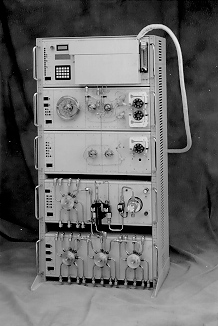
(Automated Sampling and Analytical Platform)
Analytical and Remedial Technology, Inc. (A+RT), produces components that
can be assembled in various configurations to allow automated sampling and
analysis of water streams. The A+RT components are mounted in a custom case
to produce an automated sampling and analytical platform (ASAP). A complete
ASAP system consists of the following basic components:
The photograph below illustrates an ASAP configured for automated sampling of 29 points using 0.25-inch stainless steel tubing. The A+RT purge-and-trap concentrator draws a precise volume of water (selectable from 0.2 to 10 milliliters) from the selected sample stream and prepares it for volatile organic compound (VOC) analysis using a gas chromatograph. The A+RT concentrator differs from the customary batch purging approach in that it uses a flow-through, countercurrent stripping cell.
Automated Sampling and Analytical Platform
The A+RT high performance liquid chromatograph (HPLC) sample preparation module collects a sample in a fixed volume loop and delivers it to the HPLC. With additional components, the module can support a second channel for HPLC analysis along with either automated or manual sample selection. The module can also be configured to process the samples using solid-phase extraction. This process concentrates analytes, which are then backflushed with solvent and extracted for subsequent HPLC analysis.
An optional Grundfos pump interface module (GPIM) allows the ASAP, for a given sample, to select and operate one of up to 48 Grundfos RediFlo-2™ 2-inch submersible pumps connected to the ASAP. Thus, this module allows automatic sampling of groundwater for groundwater depths greater than 15 to 20 feet below surface. Control of up to 48 pumps requires only one Grundfos MP1 controller interfaced with the GPIM.
The A+RT components and software are designed to allow continuous (24-hour) monitoring for long periods of time (months to years) with automated continuing calibration checks and recalibration when necessary. The ASAP is designed to be installed with the other system components permanently or semipermanently in a secure, temperature-controlled space on site.
The ASAP is designed for automated sampling and analysis of aqueous samples, such as those obtained from a treatment or process stream or from wells emplaced in a groundwater contaminant plume. The ASAP can be configured for a wide variety of contaminants, including VOCs, polynuclear aromatic hydrocarbons, ionizable organic chemicals, and a range of inorganic substances.
Several commercial ASAP systems have been purchased by universities for use in groundwater remediation research at U.S. Department of Defense facilities. The ASAP has considerably broader capabilities than the prototype system (the Automated Volatile Organics Analytical System, or AVOAS) evaluated under the SITE Program. The AVOAS was demonstrated in May 1991 at the Wells G and H Superfund site in EPA Region 1. The results of the demonstration have been published by EPA ("Automated On-Site Measurement of Volatile Organics in Water," EPA/600/R-93/109, June 1993).
EPA PROJECT MANAGER:
Stephen Billets
U.S. EPA
National Exposure Research Laboratory
Characterization Research Division
P.O. Box 93478
Las Vegas, NV 89193-3478
702-798-2232
Fax: 702-798-2261
TECHNOLOGY DEVELOPER CONTACT:
Gary Hopkins
Analytical and Remedial Technology, Inc.
473 Gemma Drive
Milpitas, CA 95035
408-263-8931
Fax: 408-263-8931