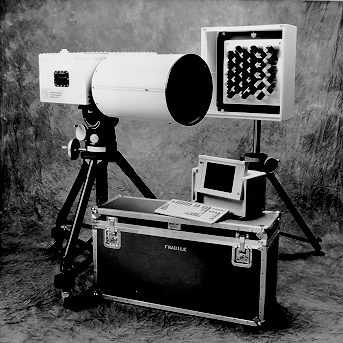
This air monitoring system (see photograph below) is a field-deployable, open-path Fourier transform infrared (FTIR) spectrometer that measures infrared absorption by infrared-active molecules. The spectrometer system transmits an infrared beam along an open air path to a retroflector target that returns it to the spectrometer. The total air path can be up to 1 kilometer long. Analysis is performed using a quantitative reference spectrum of known concentration, together with classical least squares data fitting software routines. The system does not require acquisition of an air sample; this factor enhances data integrity by eliminating the potential for error inherent to many air sampling techniques.
AirSentry Fourier Transform Infrared Spectrometer
A measurement over several hundred meters requires only a few minutes, which allows determination of temporal profiles for pollutant gas concentrations. The spectrometer requires performance verification procedures, but does not require calibration.
The AirSentry FTIR spectrometer can measure various airborne vapors, including both organic and inorganic compounds, especially those that are too volatile to be collected by preconcentration methods. It can be used to monitor emissions from hazardous waste sites during remediation and removal.
The AirSentry FTIR spectrometer was demonstrated during a 1990 SITE study at Shaver's Farm, a Superfund site in northwest Georgia. The purpose of this demonstration was to test performance during remedial activities and to develop and test on-site quality assurance procedures. Results of this study were published in a paper titled "Use of a Fourier Transform Spectrometer As a Remote Sensor at Superfund Sites," presented at a 1991 conference.
The AirSentry FTIR spectrometer has been evaluated in several other field studies and has been proven capable of detecting various airborne atmospheric vapors. The AirSentry FTIR gas analysis software, which automatically identifies and quantifies compounds in the presence of background interferences, was evaluated in a 1991 field study sponsored by EPA Region 7. Results of this field evaluation are published in an EPA report titled "A Field-Based Intercomparison of the Qualitative and Quantitative Performance of Multiple Open-Path FTIR Systems for Measurement of Selected Toxic Air Pollutants."
Another field evaluation of the AirSentry FTIR spectrometer was conducted at a Superfund site in January 1992. During the field evaluation, the FTIR spectrometer was compared with gas chromatography/mass spectrometry techniques using air samples collected in canisters. Results from this field evaluation are published in an EPA report titled "Superfund Innovative Technology Evaluation, The Delaware SITE Study, 1992" (EPA/600/A3-91/071).
Using other funding sources, EPA has continued research in this area and has released a guidance document applicable to all FTIR-based open path monitoring systems. The document is available from EPA (EPA/600/R-96/040). A guidance document detailing the steps required for successful field operation of the FTIR-based open path monitoring system is available from EPA in draft form. For a copy of the draft document, contact the EPA Project Manager listed below. The final version of the document will be added to the "EPA Compendium of Methods for Determination of Toxic Organic Compounds in the Ambient Air" as method TO-16.
This technology is no longer available from the developer. For further information about the technology, contact the EPA Project Manager.
EPA PROJECT MANAGER:
William McClenny
U.S. EPA
National Exposure Research Laboratory
MD-44
Research Triangle Park, NC 27711
919-541-3158
Fax: 919-541-3527