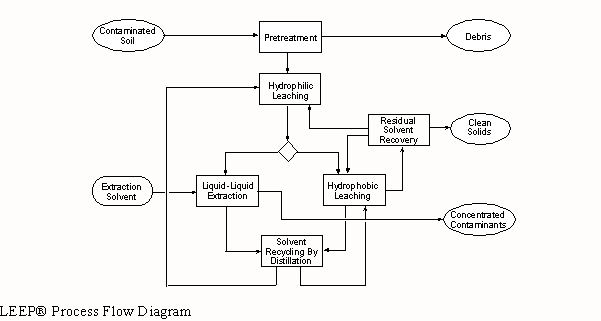
The patented Low-Energy Extraction Process (LEEP®) uses common organic solvents to concentrate and extract organic pollutants from soil, sediments, and sludges. LEEP® can treat contaminated solids to the stringent cleanup levels mandated by regulatory agencies. LEEP® includes pretreatment, washing, and concentration processes (see figure below).
During pretreatment, particles measuring up to 8 inches in diameter are removed in a gravity settler-floater. The settler-floater includes a metal detector and remover, a crusher, and a metering feeder. Floating material often found at remediation sites, such as wood chips, grass, or root material, is also removed.
After pretreatment, the solid matrix is washed in a unique, dual solvent process that uses both hydrophilic and hydrophobic solvents. The combination of these proprietary solvents guarantees efficient contaminant removal. The extracted pollutants are then concentrated in a sacrificial solvent by liquid-liquid extraction or by distillation, and are removed from the process for off-site disposal or recycling. The treated solids can be returned to the site as clean fill.
LEEP® is a low-pressure process operated at near-ambient conditions. It is designed as a closed-loop, self-contained, mobile unit consisting of proven heavy-duty equipment. The relatively inexpensive solvents used in the process are internally recycled. The solvents are applicable to almost every type of organic contaminant, and their physical properties enhance clay and silt particle settling.
LEEP® can treat most organic contaminants in soil, sediment, and sludge, including tar, creosote, chlorinated hydrocarbons, polynuclear aromatic hydrocarbons, pesticides, and wood- preserving chlorophenol formulations. Bench- and pilot-scale experiments have shown that LEEP® effectively treats tar-contaminated solids from manufactured gas plant sites, soils and sediments contaminated with polychlorinated biphenyls and refinery waste sludges, and soils contaminated with petroleum hydrocarbons.
LEEP® was accepted into the Emerging Technology Program in July 1989. Bench-scale studies for process development were completed in 1994. A draft report which details the evaluation results has been submitted to EPA. The final report will be available in 1997.
In addition, ART International, Inc., routinely conducts bench-scale treatability
studies for government and industrial clients, and has obtained Toxic Substances
Control Act, Resource Conservation and Recovery Act, and air permits for
the technology. Other developments include the following:
In 1994, Soil Extraction Technologies, Inc., a wholly owned subsidiary of Public Service Electric & Gas, purchased a LEEP® license.
EPA PROJECT MANAGER:
Jack Hubbard
U.S. EPA
National Risk Management Research Laboratory
26 West Martin Luther King Drive
Cincinnati, OH 46268
513-569-7507
Fax: 513-569-7620
TECHNOLOGY DEVELOPER CONTACT:
Werner Steiner
ART International, Inc.
100 Ford Road
Denville, NJ 07834
201-627-7601
Fax: 201-627-6524