(In Situ Electroacoustic Soil Decontamination)
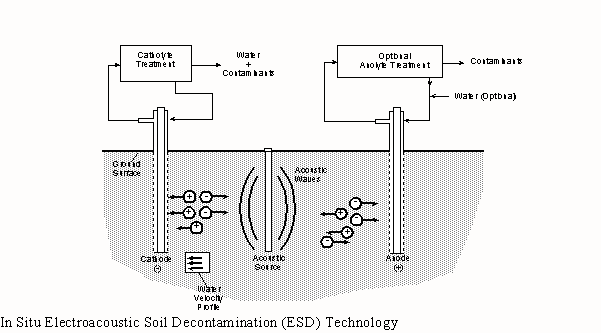
This patented in situ electroacoustic soil decontamination (ESD) technology removes heavy metals from soils through direct current electrical and acoustic fields. Direct current facilitates liquid transport through soils. The technology consists of electrodes, an anode and a cathode, and an acoustic source (see figure below).
The double-layer boundary theory is important when an electric potential is applied to soils. For soil particles, the double layer consists of (1) a fixed layer of negative ions that are firmly held to the solid phase, and (2) a diffuse layer of more loosely held cations and anions. Applying an electric potential to the double layer displaces the loosely held ions to their respective electrodes. The cations take water with them as they move toward the cathode.
Besides water transport through wet soils, the direct current produces other effects, such as ion transfer, pH gradients development, electrolysis, oxidation and reduction, and heat generation. Heavy metals present in contaminated soils can be leached or precipitated out of solution by electrolysis, oxidation and reduction reactions, or ionic migration. The soil contaminants may be (1) cations, such as cadmium, chromium, and lead; or (2) anions, such as cyanide, chromate, and dichromate. The existence of these ions in their respective oxidation states depends on soil pH and concentration gradients. Direct current is expected to increase the leaching rate and precipitate the heavy metals out of solution by establishing appropriate pH and osmotic gradients.
This technology removes heavy metals from soils. When applied in conjunction with an electric field and water flow, an acoustic field can enhance waste dewatering or leaching. This phenomenon is not fully understood. Another possible application involves the unclogging of recovery wells. Because contaminated particles are driven to the recovery well, the pores and interstitial spaces in the soil can close. This technology could be used to clear these clogged spaces.
The technology's potential for improving nonaqueous phase liquid contaminant recovery and in situ removal of heavy metals needs to be tested at the pilot-scale level using clay soils.
The ESD technology was accepted into the SITE Emerging Technology Program in 1988. Results indicate that ESD is technically feasible for removing inorganic species such as zinc and cadmium from clay soils; it is only marginally effective for hydrocarbon removal. A modified ESD process for more effective hydrocarbon removal has been developed but not tested. The Emerging Technology Report (EPA/540/5-90/004) describing the 1-year investigation can be purchased through the National Technical Information Service, (PB 90-204728/AS). The Emerging Technology Summary (EPA/540/S5-90/004) is available from EPA.
EPA PROJECT MANAGER:
Randy Parker
U.S. EPA
National Risk Management Research Laboratory
26 West Martin Luther King Drive
Cincinnati, OH 45268
513-569-7271
Fax: 513-569-7571
TECHNOLOGY DEVELOPER CONTACT:
Satya Chauhan
Battelle Memorial Institute
505 King Avenue
Columbus, OH 43201
614-424-4812
Fax: 614-424-3321