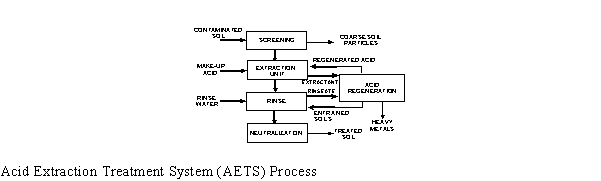
(Acid Extraction Treatment System)
The acid extraction treatment system (AETS) uses hydrochloric acid to extract heavy metal contaminants from soils. Following treatment, the clean soil may be returned to the site or used as fill.
A simplified block flow diagram of the AETS is shown below. First, soils are screened to remove coarse solids. These solids, typically greater than 4 millimeters in size, are relatively clean and require at most a simple rinse with water or detergent to remove smaller attached particles.
After coarse particle removal, the remaining soil is scrubbed in an attrition scrubber to break up agglomerates and cleanse surfaces. Hydrochloric acid is then introduced into the soil in the extraction unit. The residence time in the unit varies depending on the soil type, contaminants, and contaminant concentrations, but generally ranges between 10 and 40 minutes. The soil-extractant mixture is continuously pumped out of the mixing tank, and the soil and extractant are separated using hydrocyclones.
When extraction is complete, the solids are transferred to the rinse system. The soils are rinsed with water to remove entrained acid and metals. The extraction solution and rinse waters are regenerated using a proprietary technology that removes the metals and reforms the acid. The heavy metals are concentrated in a form potentially suitable for recovery. During the final step, the soils are mixed with lime and fertilizer to neutralize any residual acid. No wastewater streams are generated by the process.
The main application of AETS is extraction of heavy metals from soils. The system has been tested using a variety of soils containing one or more of the following: arsenic, cadmium, chromium, copper, lead, nickel, and zinc. The treatment capacity is expected to range up to 30 tons per hour. AETS can treat all soil fractions, including fines.
The major residuals from AETS treatment include the cleaned soil, which is suitable for fill or for return to the site, and the heavy metal concentrate. Depending on the concentration of heavy metals, the mixtures of heavy metals found at the site, and the presence of other compounds (calcium, sodium) with the metals, heavy metals may be reclaimed from the concentrate.
Under the Emerging Technology Program, laboratory-scale and bench-scale tests
were conducted to develop the AETS technology. The bench-scale pilot system
was constructed to process between 20 and 100 kilograms of soil per hour.
Five soils were tested, including an EPA synthetic soil matrix (SSM) and
soils from four Superfund sites, including NL Industries in Pedricktown,
New Jersey; King of Prussia site in Winslow Township, New Jersey; a smelter
site in Butte, Montana; and Palmerton Zinc site in Palmerton, Pennsylvania.
These soils contained elevated concentrations of some or all of the following:
arsenic, cadmium, chromium, copper, lead, nickel, and zinc. The table below
summarizes soil treatability results based on the EPA Resource Conservation
and Recovery Act (RCRA) hazardous waste requirements for toxicity characteristic
leaching procedure (TCLP) and the California standards for total metal
concentrations. The Emerging Technology Report (EPA/540/R-94/513) and Emerging
Technology Summary (EPA/540/SR-94/513) are available from EPA. The results
of the study are summarized below:
Treatment costs under expected process conditions range from $100 to $180 per cubic yard of soil, depending on the site size, soil types, and contaminant concentrations. Operating costs ranged from $50 to $80 per cubic yard.
Soil |
|||||
|---|---|---|---|---|---|
| Metal | SSM | Butte | King of Prussia | Pedricktown | Palmerton |
As |
*,T,L |
*,T,L |
|
|
|
Cd |
*,T |
*,T,L |
|||
Cr |
*,T,L |
*,T,L |
*,T,L |
||
Cu |
*,T,L |
*,T,L |
*,T,L |
*,T,L |
|
Nl |
*,T,L |
*,T,L |
|||
Pb |
* |
*,T,L |
*,T,L |
*,T,L |
|
Zn |
*,T,L |
*,T,L |
*,T,L |
*,T,L |
|
| Key: | * -- Metal is present in that soil T -- Successful treatment for total metals L -- Reduction in leachability to below standards Boldface font indicates high initial metals concentration (at least double the regulatory standards) |
EPA PROJECT MANAGER:
George Moore
U.S. EPA
National Risk Management Research Laboratory
26 West Martin Luther King Drive
Cincinnati, OH 45268
513-569-7991
Fax: 513-569-7276
TECHNOLOGY DEVELOPER CONTACT:
Stephen Paff
Center for Hazardous Materials Research
320 William Pitt Way
Pittsburgh, PA 15238
412-826-5321, ext. 233
Fax: 412-826-5552