The FORAGER® Sponge (Sponge) is an open-celled cellulose sponge containing a polymer with selective affinity for dissolved heavy metals in both cationic and anionic states. The polymer contains iminodiacetic acid groups which enter into chelation bonding with transition-group heavy metal cations. The polymer's affinity for particular cations is influenced by solution parameters such as pH, temperature, and total ionic content. In general, the following affinity sequence for several representative ions prevails:
Cd++ > Cu++ > Hg++ > Pb++ > Au+++ > Zn++ > Fe+++ > Ni++ > Co++ >> Al+++ > Ca++ > Mg++ >> Na+
During absorption, a cation is displaced from the polymer. The displaced cation may be H+ or a cation below the absorbed cation in the affinity sequence.
The polymer also contains tertiary amine salt groups which exhibit selective bonding for anion species such as the following:
CrO4-², AsO4-³, Au(CN)2-, SeO4-², HgCl3-, Ag(S2O3)-³, SiO3-², UO4-²
The absorption of certain anion species can be enhanced by preabsorption of a cation that ordinarily reacts with a sought anion to produce a highly insoluble compound. For example, a Sponge presaturated with Fe+3 strongly absorbs arsenate anion because ferric arsenate is highly insoluble.
The removal efficiency for transition-group heavy metals is about 90 percent at a flow rate of 0.1 bed volume per minute. The Sponge's highly porous nature speeds diffusional effects, promoting high rates of ion absorption. The Sponge can be used in columns, fishnet-type enclosures, or rotating drums. When used in a column, flow rates of three bed volumes per minute can be obtained at hydrostatic pressures only 2 feet above the bed and without additional pressurization. Therefore, Sponge-packed columns are suitable for unattended field use.
Absorbed ions can be eluted from the Sponge using techniques typically employed to regenerate ion-exchange resins and activated carbon. Following elution, the Sponge can be used in the next absorption cycle. The number of useful cycles depends on the nature of the absorbed ions and the elution technique used. Alternatively, the metal-saturated Sponge can be incinerated. In some instances, the Sponge may be dried and reduced in volume to facilitate disposal.
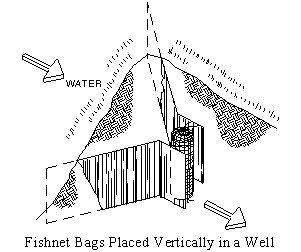
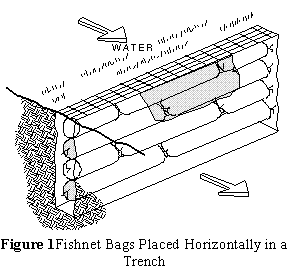
A trailer-mounted pump-and-treat apparatus can handle up to 10 gallons per minute with low pumping pressures of 4 to 10 pounds per square inch. The apparatus employs four or six Plexiglas columns, connected in series, with valving to expedite regeneration and staging. Each column accommodates a fishnet container of Sponge in the form of half-inch cubes. Groundwater can be remediated in situ using elongated fishnet bags that confine the Sponge. The bags are placed vertically in wells, as shown in the figure below, or placed horizontally in trenches, as shown in the second figure. Alternatively, the groundwater can be treated aboveground in a packed column configuration.
The Sponge can scavenge metals in concentration levels of parts per million and parts per billion from industrial discharges, municipal sewage, process streams, and acid mine drainage. The Sponge is particularly useful when treating water with low contaminant levels, especially in polishing or end-of-pipe treatments. Because of the low capital investment required, the Sponge is well-suited for use in short-term remediation projects and for sporadic flows conditions.
This technology was accepted into the SITE Demonstration Program in June 1991. The Sponge was demonstrated in April 1994 at the National Lead Industry site in Pedricktown, New Jersey. The Demonstration Bulletin (EPA/540/MR-94/522), Technology Capsule (EPA/540/R-94/522a), and Innovative Technology Evaluation Report (EPA/540/R-94/522) are available from EPA.
The Sponge has also effectively removed trace heavy metals from acid mine drainage at three locations in Colorado. In bench-scale tests, the Sponge reduced mercury, lead, nickel, cadmium, and chromium in groundwater from various Superfund locations to below detectable levels. The Sponge was also demonstrated in a field-scale installation at a photoprocessing operation. The process reduced chromate and silver by 75 percent at a cost of $1,100 per month. In bench-scale tests, the Sponge has removed lead, mercury, and copper from pourable sludges such as simulated municipal sewage, and from soils slurried with water.
DEMONSTRATION RESULTS:
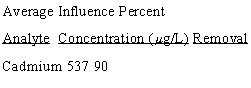
Treatment performance from the SITE demonstration was as follows:
In 1996, the Sponge, configured in a column, was employed in a pump-and-treat remediation of 360,000 gallons of water that had accumulated as a result of a fuel handling operation. The water, containing 0.2 parts per million (ppm) arsenic, was treated at 12 gallons per minute (0.1 bed volume per minute) to produce an effluent having a nondetect level of arsenic.
TECHNOLOGY DEVELOPER CONTACT:
Norman Rainer
Dynaphore, Inc.
2709 Willard Road
Richmond, VA 23294
804-288-7109
Fax: 804-282-1325