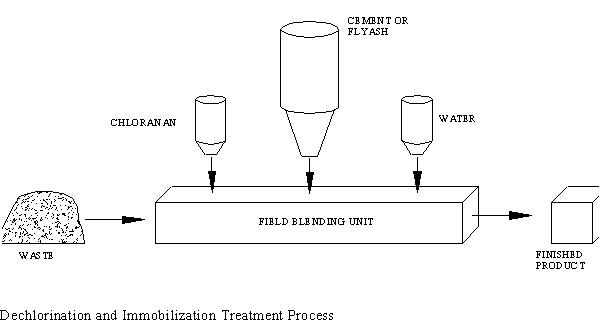
This technology mixes hazardous wastes with cement (or fly ash), water, and one of 18 patented reagents, commonly known as Chloranan, to immobilize heavy metals. The developers also claim that certain chlorinated organics are dechlorinated by the treatment reagents.
Soils, sludges, and sediments can be treated in situ or excavated and treated ex situ. Sediments can be treated under water. In the finished product, immobilized metals have a very low solubility.
Ex situ treatment occurs in batches, with volumetric throughput rated at 120 tons per hour. The treatment process begins by adding Chloranan and water to the blending unit (see figure below). Waste is then added and mixed for 2 minutes. Cement or fly ash is added and mixed for a similar time. After 12 hours, the treated material hardens into a concrete-like mass that exhibits unconfined compressive strengths (UCS) ranging from 1,000 to 3,000 pounds per square inch (psi), with permeabilities of 10-9 centimeters per second (cm/sec). The hardened concrete-like mass can withstand several hundred freeze and thaw cycles.
The technology is applicable to solid wastes containing heavy metals and organics. The developer claims that, since the 1987 SITE demonstration, the technology has been refined to dechlorinate certain chlorinated organics and to immobilize other wastes, including those with high levels of metals. Wastes with organic and inorganic contaminants can be treated together. The process can treat contaminated material with high concentrations (up to 25 percent) of oil.
This technology was accepted into the SITE Demonstration Program in 1987. The process was demonstrated in October 1987 at a former oil processing plant in Douglassville, Pennsylvania. The site soil contained high levels of oil and grease (250,000 parts per million [ppm]) and heavy metals (22,000 ppm lead), and low levels of volatile organic compounds (VOC) (100 ppm) and polychlorinated biphenyls (PCB) (75 ppm). The Applications Analysis Report (EPA/540/A5-89/001) and Technology Evaluation Report (EPA/540/5-89/001a) are available from EPA. A report on long-term monitoring may be also obtained from EPA. The technology has also been used to remediate a California Superfund site with zinc contamination as high as 220,000 ppm.
Since the demonstration in 1987, 17 additional reagent formulations have been developed. These reagents supposedly dechlorinate many chlorinated organics, including PCBs, ethylene dichloride, trichloroethene, and pentachlorophenol.
For the SITE demonstration, samples were taken after treatment at intervals of 7 days, 28 days, 9 months, and 22 months. Analytical results from these samples were generally favorable. The physical test results indicated a UCS between 220 and 1,570 psi. Low permeabilities (10-9 cm/sec) were recorded, and the porosity of the treated wastes was moderate. Durability test results showed no change in physical strength after the wet and dry and freeze and thaw cycles. The waste volume increased by about 120 percent. However, technology refinements now restrict volumetric increases to 15 to 25 percent. Using a smaller volume of additives reduces physical strength, but toxicity reduction is not affected.
The results of the leaching tests were mixed. Toxicity characteristic leaching procedure (TCLP) results for the stabilized wastes showed that concentrations of metals, VOCs, and semivolatile organic compounds (SVOC) were below 1 ppm. Lead concentrations in leachate decreased by a factor of 200 to below 100 parts per billion. VOC and SVOC concentrations in the TCLP leachate were not affected by treatment. Oil and grease concentrations were greater in the treated waste TCLP leachate (4 ppm) than in the untreated waste TCLP leachate (less than 2 ppm).
EPA PROJECT MANAGER:
Paul dePercin
U.S. EPA
National Risk Management Research Laboratory
26 West Martin Luther King Drive
Cincinnati, OH 45268
513-569-7797
Fax: 513-569-7105
E-Mail:
dePercin.Paul@epamail.epa.gov
TECHNOLOGY DEVELOPER CONTACT:
Ray Funderburk
Funderburk & Associates
916 Allegro Lane
Apollo Beach, FL 33572
800-723-8847
Fax: 813-645-9620