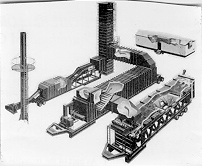
The infrared thermal destruction technology is a mobile thermal processing system that uses electrically powered silicon carbide rods to heat organic wastes to combustion temperatures. Any remaining combustibles are incinerated in an afterburner. One configuration for this mobile system (see figure below) consists of four components: (1) an electric-powered infrared primary chamber; (2) a gas-fired secondary combustion chamber; (3) an emissions control system; and (4) a control center.
Mobile Thermal Processing System
Waste is fed into the primary chamber and exposed to infrared radiant heat (up to 1,850 ºF) provided by silicon carbide rods above the conveyor belt. A blower delivers air to selected locations along the belt to control the oxidation rate of the waste feed.
The ash material in the primary chamber is quenched with scrubber water effluent. The ash is then conveyed to an ash hopper, where it is removed to a holding area and analyzed for organic contaminants such as polychlorinated biphenyls (PCB).
Volatile gases from the primary chamber flow into the secondary chamber, which uses higher temperatures, greater residence time, turbulence, and supplemental energy (if required) to destroy these gases. Gases from the secondary chamber are ducted through the emissions control system. In the emissions control system, the particulates are removed in a venturi scrubber. Acid vapor is neutralized in a packed tower scrubber. An induced draft blower draws the cleaned gases from the scrubber into the free-standing exhaust stack. The scrubber liquid effluent flows into a clarifier, where scrubber sludge settles and is removed for disposal. The liquid then flows through an activated carbon filter for reuse or to a publicly owned treatment works for disposal.
This technology is suitable for soils or sediments with organic contaminants.
Liquid organic wastes can be treated after mixing with sand or soil. Optimal
waste characteristics are as follows:
EPA conducted two evaluations of the infrared thermal destruction technology. A full-scale unit was evaluated during August 1987 at the Peak Oil Superfund site in Brandon, Florida. The system treated nearly 7,000 cubic yards of waste oil sludge containing PCBs and lead. A pilot-scale demonstration took place at the Rose Township-Demode Road Superfund site in Michigan during November 1987. Organics, PCBs, and metals in soil were the target waste compounds. Two Applications Analysis Reports (EPA/540/A5-89/010 and EPA/540/A5-89/007) and two Technology Evaluation Reports (EPA/540/5-88/002a and EPA/540/5-89/007a) are available from EPA. In addition, the technology has been used to remediate PCB contamination at the Florida Steel Corporation and the LaSalle Electric Superfund sites.
This technology is no longer available through vendors in the United States. For further information about the technology, contact the EPA Project Manager.
The results from the two SITE demonstrations are summarized below.
EPA PROJECT MANAGER:
Laurel Staley
U.S. EPA
National Risk Management Research Laboratory
26 West Martin Luther King Drive
Cincinnati, OH 45268
513-569-7863
Fax: 513-569-7105