High-voltage electron irradiation of water produces a large number of very reactive chemical species, including the aqueous electron (e-aq), the hydrogen radical (H+), and the hydroxyl radical (OH+). These short-lived intermediates break down organic contaminants in aqueous wastes.
In the principal reaction, the aqueous electron transfers to halogen-containing compounds, breaking the halogen-carbon bond and liberating halogen anions such as chloride (Cl-) or bromide (Br-). The hydroxyl radical can undergo addition or hydrogen abstraction reactions, producing organic free radicals that decompose in the presence of other hydroxyl radicals and water. In most cases, organics are converted to carbon dioxide, water, and salts. Lower molecular weight aldehydes, haloacetic acids, and carboxylic acids form at low concentrations in some cases.
During the high-voltage electron irradiation process, electricity generates high energy electrons. The electrons are accelerated by the voltage to approximately 95 percent of the speed of light. They are then directed into a thin stream of water or sludge. All reactions are complete in less than 0.1 second. The electron beam and waste flow are adjusted to deliver the necessary dose of electrons. Although this is a form of ionizing radiation, there is no residual radioactivity.
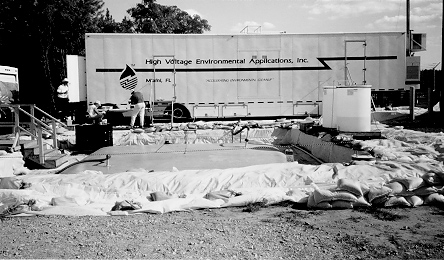
High Voltage Environmental Applications, Inc. (High Voltage), has developed a mobile facility to demonstrate the treatment process (see photograph below).
The Mobile Electron Beam Hazardous Waste Treatment System
This treatment process can effectively treat more than 100 common organic
compounds. These compounds include the following:
The treatment process is appropriate for removing various hazardous organic compounds from aqueous waste streams and sludges.
The high-energy electron irradiation process was accepted into the SITE Emerging Technology Program (ETP) in June 1990. For further information on the pilot-scale facility evaluated under the ETP, refer to the Emerging Technology Bulletins (EPA/540/F-93/502, EPA/540/F-92/009, and EPA/540/F-93/509), which are available from EPA. Based on results from ETP, the process was invited to participate in the Demonstration Program.
The ability of the technology to treat contaminated soils, sediments, or sludges is also being evaluated under the ETP. For further information on this evaluation, refer to the the High Voltage profile in the ETP section (ongoing projects).
The treatment process was demonstrated at the U.S. Department of Energy's Savannah River site in Aiken, South Carolina during two different periods totaling 3 weeks in September and November 1994. The demonstration of a trailer-mounted treatment system took place on a portion of the Savannah River site known as M-Area.
During the demonstration, the system treated about 70,000 gallons of M-Area groundwater contaminated with volatile organic compounds (VOC). The principal groundwater contaminants were TCE and PCE, which were present at concentrations of about 27,000 and 11,000 micrograms per liter (µg/L), respectively. The groundwater also contained low levels of cis-1,2-dichloroethene (40 µg/L). The following compounds were also spiked into the influent stream at approximately 500 µg/L: 1,2-dichloroethane, carbon tetrachloride, 1,1,1-trichloroethane, chloroform, and BTEX.
The highest VOC removal efficiencies were observed for TCE (99.5 percent), PCE (99.0 percent), and dichloroethene (greater than 99 percent). Removal efficiencies for chlorinated spiking compounds ranged from 68 to 98 percent, and removal efficiencies for BTEX ranged from 88 to 99.5 percent.
EPA PROJECT MANAGER:
Franklin Alvarez
U.S. EPA
National Risk Management Research Laboratory
26 West Martin Luther King Drive
Cincinnati, OH 45268
513-569-7631
Fax: 513-569-7571
TECHNOLOGY DEVELOPER CONTACT:
William Cooper
High Voltage Environmental Applications, Inc.
9562 Doral Boulevard
Miami, FL 33178
305-593-5330
Fax: 305-593-0071