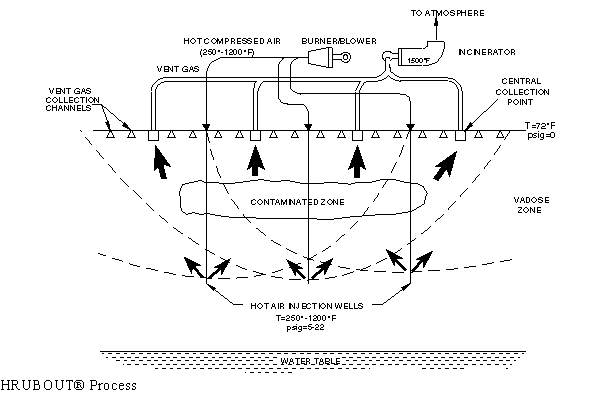
The HRUBOUT® process is a thermal, in situ and ex situ treatment process designed to remove volatile organic compounds (VOC) and semivolatile organic compounds (SVOC) from contaminated soils. The in situ process is shown in the figure below. Heated air is injected into the soil below the contamination zone, evaporating soil moisture and removing volatile and semivolatile hydrocarbons. As the water evaporates, soil porosity and permeability increase, further facilitating the air flow at higher temperatures. As the soil temperature increases further, the less volatile constituents volatilize or are thermally oxidized.
Injection wells are drilled in a predetermined distribution pattern to depths below the contamination zone. The wells are equipped with steel casing, perforated at the bottom, and cemented into the hole above the perforations. Heated, compressed air is introduced at temperatures of up to 1,200 °F, and the pressure is slowly increased. As the air progresses upward through the soil, the moisture is evaporated, removing the VOCs and SVOCs. A surface collection system captures the exhaust gases under negative pressure. These gases are transferred to a thermal oxidizer, where the hydrocarbons are thermally destroyed in an incinerator at a temperature of 1,500 °F.
The air is heated in an adiabatic burner at 2.9 million British thermal units per hour (MMBtu/hr). The incinerator has a rating of 3.1 MMBtu/hr. The air blower can deliver up to 8,500 pounds per hour. The units employ a fully modulating fuel train that is fueled by natural gas or propane. All equipment is mounted on custom-designed mobile units and can operate 24 hours per day.
The HRUBOUT® process can remediate soils contaminated with halogenated or nonhalogenated organic volatiles and semivolatiles, such as gasoline, diesel oil, jet fuel, heating oil, chemical solvents or other hydrocarbon compounds.
The HRUBOUT® process was accepted into the SITE Demonstration Program in July 1992. The technology was demonstrated at Kelly Air Force Base in San Antonio, Texas from January through February 1993. A 30-by-40-foot area of an 80,000-gallon JP-4 jet fuel spill site was chosen as the treatment area. Six heated air injection wells, spaced on a 3-by-2 grid 10 feet apart, were drilled to a depth of approximately 20 feet. The Demonstration Bulletin (EPA/540/MR-93/524) is available from EPA.
In September 1993, an in situ project was completed at the Canadian Forces military base in Ottawa, Ontario, Canada. Levels up to 1,900 parts per million (ppm) of total petroleum hydrocarbons (TPH) were encountered over a 17-by-17-foot area on the base. Five injection wells were drilled to a depth of 30 feet. After 12 days of treatment, borehole samples ranged from nondetect to 215 ppm TPH, meeting closure requirements of 450 ppm TPH.
The containerized version of the HRUBOUT® process was tested in July 1993 at a west Texas site contaminated with Varsol, or naphtha. The soil was excavated for treatment in Hrubetz's insulated container. Analysis of untreated soil revealed TPH at 1,550 ppm. Three loads were treated for about 60 to 65 hours each. Posttreatment samples ranged from nondetect to 7 ppm TPH, meeting the Texas Natural Resource Conservation Commission's background target level of 37 ppm. Large-scale mobile container units, holding up to 40 cubic yards and capable of ex situ treatment of a load in 8 hours, are under development.
The ex situ version of the technology was selected to remediate a site in Toronto, Ontario, Canada, which consisted of about 1,500 cubic yards (yd³) of soil contaminated with gasoline and diesel. Soil contamination was measured at 200 ppm TPH. Following treatment, seven soil samples were collected. Two samples had detectable concentrations of TPH (25 and 37 ppm) and the remaining five samples had nondetectable levels of TPH, achieving the 100 ppm TPH cleanup goal.
About 100 yd³ of toluene-contaminated soil was remediated in Orlando, Florida using the soil pile process with a smaller 5-ton unit. A composite analysis of the excavated soil found toluene at concentrations of up to 1,470 parts per billion; nondetect levels were required for closure. A composite soil sample collected after 96 hours of operation met the closure criteria.
Four patents have been granted, and additional patents are pending. The process was approved by the Texas Natural Resources Conservation Commission in 1991.
EPA PROJECT MANAGER:
Gordon Evans
U.S. EPA
National Risk Management Research Laboratory
26 West Martin Luther King Drive
Cincinnati, OH 45268
513-569-7684
Fax: 513-569-7787
TECHNOLOGY DEVELOPER CONTACTS:
Michael Hrubetz or Barbara Hrubetz
Hrubetz Environmental Services, Inc.
5949 Sherry Lane, Suite 525
Dallas, TX 75225
214-363-7833
Fax: 214-691-8545
E-Mail: psww68c@prodigy.com