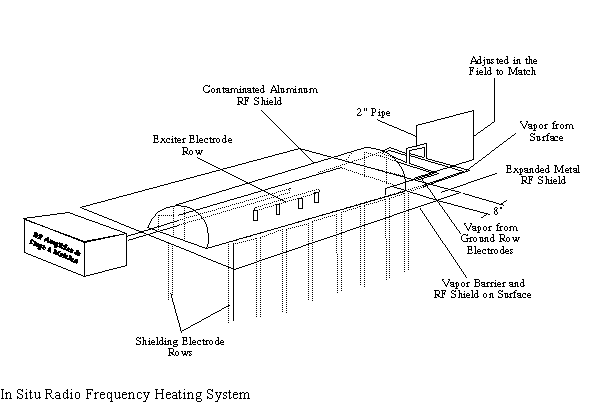
Radio frequency heating (RFH) is an in situ process that uses electromagnetic energy to heat soil and enhance soil vapor extraction (SVE). Developed by IIT Research Institute, the patented RFH technique heats a discrete volume of soil using rows of vertical electrodes embedded in soil (or other media). Heated soil volumes are bounded by two rows of ground electrodes with energy applied to a third row midway between the ground rows. The three rows act as a buried triplate capacitor. When energy is applied to the electrode array, heating begins at the top center and proceeds vertically downward and laterally outward through the soil volume. The technique can heat soils to over 300 °C.
RFH enhances SVE in two ways: (1) contaminant vapor pressures are increased by heating, and (2) the soil permeability is increased by drying. Extracted vapor can then be treated by a variety of existing technologies, such as granular activated carbon or incineration.
RFH can treat petroleum hydrocarbons, volatile organic compounds (VOC), semivolatile organic compounds (SVOC), and pesticides in soils. The technology is most efficient in subsurface areas with low groundwater recharge. In theory, the technology should be applicable to any polar compound in any nonmetallic media.
The RFH technique was accepted into the SITE Demonstration Program in summer 1992. The technique was demonstrated in August 1993 at Kelly Air Force Base (AFB), Texas, as part of a joint project with the U.S. Air Force. Brown and Root Environmental was the prime contractor evaluating and implementing RFH for the U.S. Air Force. A field demonstration of the KAI Technologies, Inc. (KAI), RFH technology was completed in June 1994 at the same site for comparison. The Demonstration Bulletin (EPA/540/MR-94/527), Technology Capsule (EPA/540/R-94/527a), and the Innovative Technology Evaluation Report (EPA/540/R-94-527) are available from EPA. For further information on the KAI technology, see the profile in the Demonstration Program section (completed projects).
In 1995, the RFH technique was tested at the former chemical waste landfill at Sandia National Laboratories in Albuquerque, New Mexico. Approximately 800 cubic yards of silty soil was heated. Preliminary results indicate that the contaminant concentration in the extracted vapors increased by a factor of 10 compared to in situ venting.
Two previous field tests were completed using in situ RFH. The first test was completed at a fire training pit, located at the Volk Air National Guard Base in Camp Douglas, Wisconsin. The sandy soil in the pit was contaminated with jet fuel. The second test was completed at Rocky Mountain Arsenal in Colorado, where clayey soil was contaminated by organochlorine pesticides.
Under the SITE demonstration, statistical analyses for the design treatment zone indicate that total recoverable petroleum hydrocarbons, pyrene, and bis(2-ethylhexyl)phthalate exhibited statistically significant decreases (at the 95 and 97.5 percent confidence levels). Chlorobenzene concentrations appeared to increase during treatment, possibly due to volatilization of chlorobenzene present in the groundwater.
Significant concentrations of 2-hexanone, 4-methyl-2-pentanone, acetone, and methyl ethyl ketone were found in the treated soils, although virtually no ketones were found before treatment. Soil temperatures as high as 1,000 °C during the demonstration may have caused partial oxidation of petroleum hydrocarbons. Alternatively, the ketones may have been volatilized from groundwater. At this time, insufficient data are available to determine the source of ketones found in treated soils.
EPA PROJECT MANAGER:
Laurel Staley
U.S. EPA
National Risk Management Research Laboratory
26 West Martin Luther King Drive
Cincinnati, OH 45268
513-569-7863
Fax: 513-569-7105
TECHNOLOGY DEVELOPER CONTACTS:
Harsh Dev
IIT Research Institute
10 West 35th Street
Chicago, IL 60616-3799
312-567-4257
Fax: 312-567-4286
Captain Jeff Stinson
U.S. Air Force Armstrong Laboratory
Environmental Risk Management, AL/EQW-OL
139 Barnes Drive, Suite 2
Tyndall AFB, FL 32403-5323
904-283-6254
Fax: 904-283-6064
Clifton Blanchard
Brown and Root Environmental
800 Oak Ridge Turnpike
Jackson Plaza, A-600
Oak Ridge, TN 37830
423-483-9900
Fax: 423-483-2014