(Oleophilic Amine-Coated Ceramic Chip)
TECHNOLOGY DESCRIPTION:
This hydrocarbon recovery technology is based on an oleophilic, amine-coated ceramic chip that separates suspended and dissolved hydrocarbons, as well as most mechanical and some chemical emulsions, from aqueous solutions. The oleophilic chip is manufactured by grafting a hydrophobic amine to a mineral support, in this case a ceramic substrate. Each granule is 0.6 to 1 millimeter in diameter, but is very porous and thus has a large surface area. The hydrophobic property of the amine coating makes each granule more effective for microfiltration of hydrocarbons in an unstable emulsion.
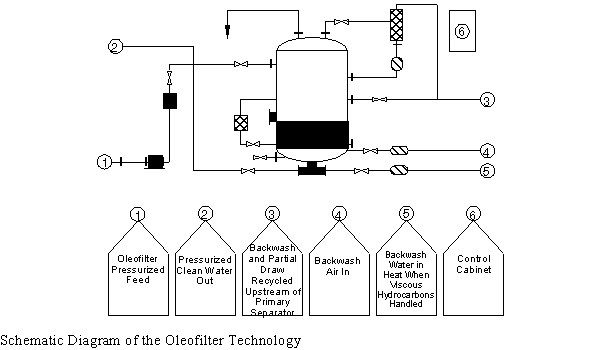
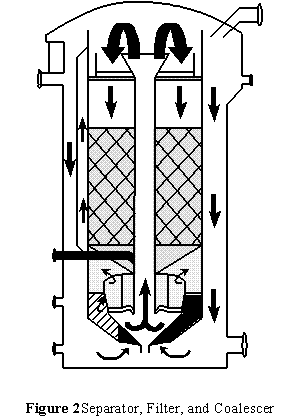
The figure below illustrates the process; the separator, filter, and coalescer unit is shown on the next page. The pressure-sensitive filtering bed is regenerated by automatic backflushing. This automatic regeneration eliminates the expense associated with regeneration of carbon and similar filtration media. Recovered hydrocarbons coalesce and can thus be removed by simple gravity separation.
This technology provides cost-effective oil and water separation, removes free and emulsified hydrocarbon contaminants, and significantly reduces hydrocarbon loading to air strippers and carbon systems. The technology can achieve a concentration of less than 7 parts per million oil and grease in the treated effluent.
WASTE APPLICABILITY:
The amine-coated granules have proven effective on a wide variety of hydrocarbons, including gasoline; crude oil; diesel fuel; benzene, toluene, ethylbenzene and xylene mixtures; and polynuclear aromatic hydrocarbons. The unit also removes hydrophobic chlorinated hydrocarbons such as pentachlorophenol, polychlorinated biphenyls, and trichloroethene, as well as vegetable and animal oils.
Treatment systems incorporating this technology have been designed for various applications, including (1) contaminated groundwater pump-and-treat systems; (2) in-process oil and water separation; (3) filtration systems; (4) combined oil and water separator-filter-coalescer systems for on-site waste reduction and material recovery; and (5) treatment of marine wastes (bilge and ballast waters).
STATUS:
This technology was accepted into the SITE Demonstration Program in December 1992. The SITE demonstration was completed in June 1994 at the Petroleum Products Corporation site in Fort Lauderdale, Florida. The site is a former oil recycling facility where groundwater has been contaminated with a variety of organic and inorganic constituents. The Demonstration Bulletin (EPA/540/MR-94/525) and Innovative Technology Evaluation Report (EPA/540/R-94/525) are available from EPA.
The technology has been used for several full-scale projects. Several separator-filter-coalescers (see figure below) are in use treating industrial process waters and oily wash waters.
DEMONSTRATION RESULTS:
For the demonstration, five separate evaluation periods (runs) were initiated. Each run used the same feed oil, except run four. The oil for run four was a 3:1 mixture of oil to kerosene. The average total recoverable petroleum hydrocarbon (TRPH) concentrations for the feed streams ranged from 422 to 2,267 milligrams per liter (mg/L). Preliminary data indicate that the system removed at least 90 percent of the TRPH from the emulsified oil and water feed stream.
For the runs where the system operated within normal design parameters, TRPH concentrations in the treated water effluent were reduced to 15 mg/L or less. The oleophilic granules achieved a 95 percent reduction of TRPH concentration for the runs with similar feed oil.
FOR FURTHER INFORMATION:
EPA PROJECT MANAGER:
Laurel Staley
U.S. EPA
National Risk Management Research Laboratory
26 West Martin Luther King Drive
Cincinnati, OH 45268
513-569-7863
Fax: 513-569-7620
TECHNOLOGY DEVELOPER CONTACT:
Alan Bell
North American Technologies Group, Inc.
4710 Bellaire Boulevard, Suite 301
Bellaire, TX 77401
713-662-2699
Fax: 713-662-3728