(Fungal Treatment Technology)
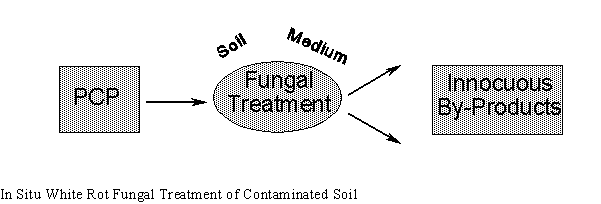
This biological treatment system uses lignin-degrading fungi to treat excavated soils. These fungi have been shown to biodegrade a wide catalogue of organic contaminants.
The contaminated soil is inoculated with an organic carrier infested with the selected fungal strain. The fungi break down soil contaminants, using enzymes normally produced for wood degradation as well as other enzyme systems.
This technology has the greatest degree of success when optimal growing conditions for the fungi are used. These conditions include moisture control (at 90 percent of field capacity), and temperature and aeration control. Organic nutrients such as peat may be added to soils deficient in organic carbon.
This biological treatment system was initially applied to soil contaminated with organic chemicals found in the wood-preserving industry. These contaminants are composed of chlorinated organics and polynuclear aromatic hydrocarbons (PAH). The treatment system may remediate different contaminants and combinations of contaminants with varying degrees of success. In particular, the SITE Demonstration Program evaluated how well white rot fungi degrade pentachlorophenol (PCP) in combination with creosote PAHs.
STATUS:
This biological treatment system was accepted into the SITE Demonstration Program in April 1991. In September 1991, a treatability study was conducted at the Brookhaven Wood Preserving site in Brookhaven, Mississippi. Site soils were contaminated with 200 to 5,200 milligrams per kilogram (mg/kg) PCP and up to 4,000 mg/kg PAHs.
A full-scale demonstration of this fungal treatment technology was completed in November 1992 to obtain economic data. The Demonstration Bulletin (EPA/540/MR-93/505) is available from EPA.
The extent of treatment in the full-scale demonstration was disappointing for the time of treatment. The full-scale demonstration was hampered by excessive rainfall which did not permit the treatment beds to be sufficiently tilled. Without this processing, oxygen-depleted conditions developed, leading to loss of fungal biomass and activity. Soil bed applications of this technology may not be suitable in climates of high rainfall.
Current costs of fungal treatment operation are estimated at $150 to $200 per ton. Lower costs may be achieved with new inoculum formulations which permit reduction in the amount of inoculum mass required for treatment.
DEMONSTRATION RESULTS:
The full-scale project involved a 0.25-acre plot of contaminated soil and two smaller control plots. The soil was inoculated with Phanaerochaete sordida, a species of lignin-degrading fungus. No other amendments were added to the prepared soil. Field activities included tilling and watering all plots. No nutrients were added. The study was conducted for 20 weeks.
Some key findings from the demonstration were:
EPA PROJECT MANAGER:
Teri Richardson
U.S. EPA
National Risk Management Research Laboratory
26 West Martin Luther King Drive
Cincinnati, OH 45268
513-569-7949
Fax: 513-569-7105
TECHNOLOGY DEVELOPER CONTACTS:
John Glaser
U.S. EPA
National Risk Management Research Laboratory
26 West Martin Luther King Drive
Cincinnati, OH 45268
513-569-7568
Fax: 513-569-7105
Richard Lamar
INTECH 180 Corporation
1770 N. Research Parkway, Suite 100
North Logan, UT 84341
801-753-2111
Fax: 801-753-8321