(Hydraulic Fracturing)
TECHNOLOGY DESCRIPTION:
Hydraulic fracturing is a physical process that creates fractures in soils to enhance fluid or vapor flow in the subsurface. The technology places fractures at discrete depths with hydraulic pressurization at the base of a borehole. These fractures are placed at specific locations and depths to increase the effectiveness of treatment technologies such as soil vapor extraction, in situ bioremediation, and pump-and-treat systems. The technology is designed to enhance remediation in less permeable geologic formations.
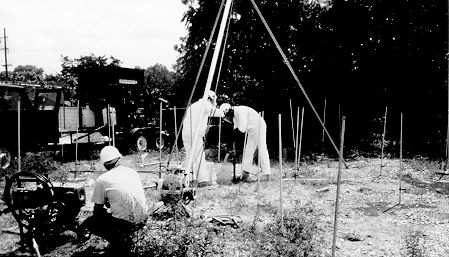
The fracturing process begins by injecting water into a sealed borehole until the water pressure exceeds a critical value and a fracture is nucleated (see photograph below). A slurry composed of a coarse-grained sand, or other granular material, and guar gum gel is then injected as the fracture grows away from the well. After pumping, the grains hold the fracture open while an enzyme additive breaks down the viscous fluid. The thinned fluid is pumped from the fracture, forming a permeable subsurface channel suitable for delivering or recovering a vapor or liquid. These fractures function as pathways for fluid movement, potentially increasing the effective area available for remediation.
Hydraulic Fracturing Process (Well is at Center of Photograph)
The hydraulic fracturing process is used in conjunction with soil vapor extraction technology to enhance recovery of contaminated soil vapors. Hydraulic fractures have recently been used to improve recovery of light nonaqueous phase liquids by increasing recovery of free product and controlling the influence of underlying water. Hydraulically induced fractures are used as channels for fluids and nutrients during in situ bioremediation. The technology has the potential to deliver nutrients and other materials to the subsurface solids useful in bioremediation. Solid nutrients or oxygen-releasing granules can be injected into the fractures.
Real-time techniques for measuring ground surface deformation have been developed to monitor the fracture positions in the subsurface.
WASTE APPLICABILITY:
Hydraulic fracturing is appropriate for enhancing soil and groundwater remediation. The technology can channel contaminants or wastes for soil vapor extraction, bioremediation, or pump-and-treat systems.
STATUS:
The hydraulic fracturing technology was accepted into the SITE Demonstration Program in July 1991. Demonstrations have been conducted in Oak Brook, Illinois and Dayton, Ohio. The hydraulic fracturing process was integrated with soil vapor extraction at the Illinois site and with in situ bioremediation at the Ohio site. The project was completed in September 1992. The Technology Evaluation and Applications Analysis Reports, which were published under one cover (EPA/540/R-93/505), and the Technology Demonstration Summary (EPA/540/SR-93/505) are available from EPA.
DEMONSTRATION RESULTS:
The first demonstration was conducted at a Xerox Corporation site in Oak
Brook, Illinois, where a vapor extraction system has been operating since
early 1991. The site is contaminated with ethylbenzene, 1,1-dichloroethane,
trichloro-ethene, tetrachloroethene, 1,1,1-trichloroethane, toluene, and
xylene. In July 1991, hydraulic fractures were created in two of the four
wells, at depths of 6, 10, and 15 feet below ground surface. The vapor flow
rate, soil vacuum, and contaminant yields from the fractured and unfractured
wells were monitored regularly. Results from this demonstration are as
follows:
Over a 1-year period, the vapor yield from hydraulically fractured wells was one order of magnitude greater than from unfractured wells.
The hydraulically fractured wells enhanced remediation over an area 30 times greater than the unfractured wells.
The presence of pore water decreased the vapor yield from wells; therefore, water must be prevented from infiltrating areas where vapor extraction is underway.
The technology was also demonstrated at a site near Dayton, Ohio, which is
contaminated with benzene, toluene, ethylbenzene, and xylene (BTEX), and
other petroleum hydrocarbons. In August 1991, hydraulic fractures were created
in one of two wells at 4, 6, 8, and 10 feet below ground surface. Sampling
was conducted before the demonstration and twice during the demonstration
at locations 5, 10, and 15 feet north of the fractured and unfractured wells.
Results from this demonstration are as follows:
The flow of water into the fractured well was two orders of magnitude greater than in the unfractured well.
The bioremediation rate near the fractured well was 75 percent higher for BTEX and 77 percent higher for total petroleum hydrocarbons compared to the rates near the unfractured well.
FOR FURTHER INFORMATION:
EPA PROJECT MANAGER:
Michael Roulier
U.S. EPA
National Risk Management Research Laboratory
26 West Martin Luther King Drive
Cincinnati, OH 45268
513-569-7796
Fax: 513-569-7620
TECHNOLOGY DEVELOPER CONTACT:
William Slack
FRX Inc.
P.O. Box 37945
Cincinnati, OH 45222
513-469-6040
Fax: 513-469-9747