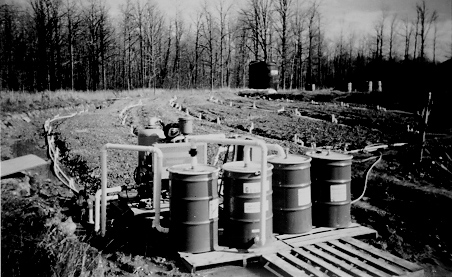
(In Situ Bioventing Treatment System)
TECHNOLOGY DESCRIPTION:
The R.E. Wright Environmental, Inc. (REWEI), process uses bioventing technology to induce aerobic biological degradation of chlorinated compounds. A series of extraction and injection wells is used to amend the soil environment, creating optimum growth conditions for the indigenous bacteria. Anhydrous ammonia and methane are injected into the subsurface to stimulate the growth of methanotrophic microorganisms. Methanotrophs have the enzymatic capabilities to degrade chlorinated solvents through a cometabolic process.
The treatment system consists of an injection and extraction well field and a soil gas extraction-amendment injection blower unit (see photograph below). The blower unit is operated in the vacuum mode long enough to adequately aerate the subsoil and provide oxygen for the aerobic bacteria. Injection wells are located between the extraction wells and are manifolded to the pressure port of the blower unit. Anhydrous ammonia is periodically injected into the subsoil to provide a source of nitrogen for the aerobic bacteria. In addition, methane gas is periodically injected to stimulate the growth of methanotrophs. The positive displacement blower unit is equipped with a moisture knockout tank, an automatic water discharge pump, and a control panel that allows remote operation of the system. Air and water discharges are typically treated with granular activated carbon prior to final discharge.
In Situ Bioventing Treatment System
Normal system monitoring consists of periodic soil sampling and analysis and soil gas monitoring. Soil samples are collected and analyzed for volatile organic compounds (VOC), soil fertility parameters, and microbiological parameters such as trichloroethene (TCE) degraders and methanotrophs. In situ respiration tests are conducted to determine the relative activity of the bacteria in the soil.
WASTE APPLICABILITY:
The technology can treat both chlorinated and nonchlorinated VOCs and semivolatile organic compounds that are biodegradable. The REWEI process was developed to treat volatile chlorinated aliphatic and aromatic hydrocarbons in the unsaturated soil zone.
STATUS:
The REWEI process was accepted into the SITE Demonstration Program in June 1994. The REWEI process was part of a pilot-scale, multivendor treatability demonstration (MVTD) that was jointly sponsored by the New York State Department of Environmental Conservation (NYSDEC), the New York State Center for Hazardous Waste Management, and the SITE Program. The objectives of the MVTD were to (1) generate field data for three biological processes, and (2) evaluate the performance of each biological process in meeting NYSDEC cleanup goals.
The demonstration took place from July to December 1994 at the Sweden 3-Chapman site in Sweden, New York and coincided with the ongoing remediation of the site. Soil at the site contained elevated levels of TCE, acetone, tetrachloroethene, dichloroethene, and toluene. The Demonstration Bulletin (EPA/540/MR-95/525) is available from EPA. The Innovative Technology Evaluation Report, which provides more detailed demonstration results, will be available in 1997.
In addition to the REWEI process, the following technologies were also
demonstrated:
SBP Technologies, Inc., Vacuum-Vaporized Well system
ENSR Consulting and Engineering and Larsen Engineers Ex Situ Biovault
For information on these technologies, refer to the NYSDEC profiles in the Demonstration Program section (completed projects).
DEMONSTRATION RESULTS:
The SITE demonstration results indicated that the REWEI process reduced contaminants in the soil. The initial mass of TCE in the soil was reduced by 92 percent with 80 percent removal attributed to biodegradation and 12 percent removed by vapor extraction. Results of the microbiological analyses indicate that the number of total heterotrophic, TCE-degrading, and methane-degrading microorganisms increased during treatment. The inorganic soil nitrogen content increased due to the subsurface injection of anhydrous ammonia.
FOR FURTHER INFORMATION:
EPA PROJECT MANAGER:
Greg Sayles
National Risk Management Research Laboratory
U.S. EPA
26 West Martin Luther Drive
Cincinnati, OH 45268
513-569-7607
Fax: 513-569-7105
TECHNOLOGY DEVELOPER CONTACTS:
Nick Kolak
New York State Department of
Environmental Conservation
50 Wolf Road, Room 268
Albany, NY 12233-7010
518-457-3372
Fax: 518-457-7743
Richard Cronce
R.E. Wright Environmental, Inc.
3240 Schoolhouse Road
Middletown, PA 17057-3595
717-944-5501
Fax: 717-944-4044