(Waste Vitrification Through Electric Melting)
Vitrification technology converts contaminated soils, sediments, and sludges into oxide glasses, chemically rendering them nontoxic and suitable for landfilling as nonhazardous materials. Successful vitrification of soils, sediments, and sludges requires (1) development of glass compositions tailored to a specific waste, and (2) glass melting technology that can convert the waste and additives into a stable glass without producing toxic emissions.
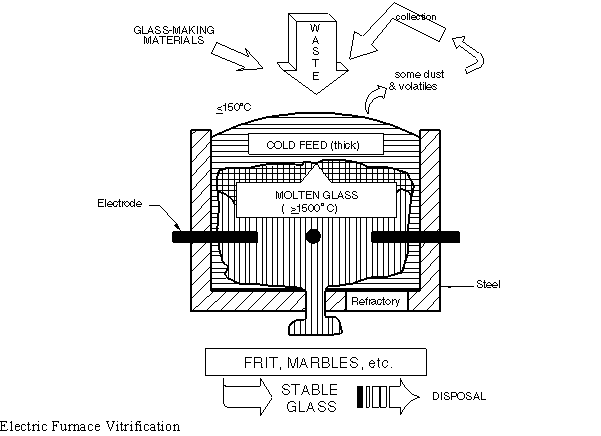
In an electric melter, glass -- an ionic conductor of relatively high electrical resistivity -- stays molten with joule heating. Such melters process waste under a relatively thick blanket of feed material, which forms a counterflow scrubber that limits volatile emissions (see figure below). Commercial electric melters have significantly reduced the loss of inorganic volatile constituents such as boric anhydride (B2O3) or lead oxide (PbO). Because of its low emission rate and small volume of exhaust gases, electric melting is a promising technology for incorporating waste into a stable glass matrix.
Vitrification stabilizes inorganic components found in hazardous waste. In addition, the high temperature involved in glass production (about 1,500 C) decomposes organics such as anthracene, bis(2-ethylhexyl phthalate), and pentachlorophenol in the waste. The decomposition products can easily be removed from the low volume of melter off-gas.
Under the Emerging Technology Program, synthetic soil matrix IV (SSM-IV) has been developed and subjected to toxicity characteristic leaching procedure (TCLP) testing.
Ten independent replicates of the preferred composition produced the following results:
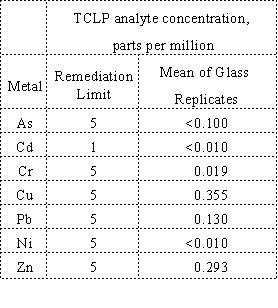
SSM-IV and additives (sand, soda ash, and other minerals) required to convert SSM-IV to the preferred glass composition have been processed in a laboratory-scale electric melter. Three separate campaigns have produced glass at 17 pounds per hour at a fill of 67 percent SSM-IV and 33 percent glass-making additives. The TCLP mean analyte concentrations were less than 10 percent of the remediation limit at a statistical confidence of 95 percent. Ferro Corporation's experience indicates that this melting rate would produce an equivalent rate of 1 ton per hour in an electric melter used to treat wastes at a Superfund site. The Emerging Technology Bulletin (EPA/540/F-95/503) is available from EPA.
EPA PROJECT MANAGER:
Randy Parker
U.S. EPA
National Risk Management Research Laboratory
26 West Martin Luther King Drive
Cincinnati, OH 45268
513-569-7271
Fax: 513-569-7571
TECHNOLOGY DEVELOPER CONTACT:
S.K. Muralidhar
Ferro Corporation
Corporate Research
7500 East Pleasant Valley Road
Independence, OH 44131
216-641-8580
Fax: 216-524-0518