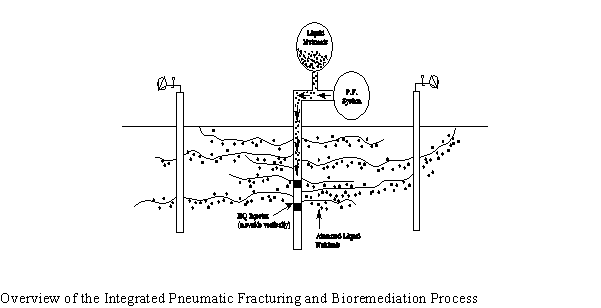
(Pneumatic Fracturing and Bioremediation Process)
The Hazardous Substance Management Research Center (HSMRC) has developed a technology for the in situ remediation of organic contaminants. The process enhances in situ bioremediation through pneumatic fracturing to establish an extended biodegradation zone supporting aerobic, denitrifying, and methanogenic populations. The technique is designed to provide faster transport of nutrients and electron acceptors (for example, oxygen and nitrate) to the microorganisms, particularly in geologic formations with moderate to low permeability.
An overview of the process is shown in the figure below. First, the formation is pneumatically fractured by applying high pressure air in 2-foot-long, discrete intervals through a proprietary device known as an HQ Injector. After the formation has been fractured with air, nutrients or other chemicals are introduced into the fracture network to stimulate biological activity. The carrier gas and the particular amendments (atomized liquid or dry media) injected into the formation can be adjusted according to the target contaminant and the desired degradation environment (aerobic, denitrifying, and anaerobic). The high air-to-liquid ratio atomizes the liquid supplements during injection, increasing their ability to penetrate the fractured formation. In the final step of the process, the site is operated as an in situ bioremediation cell to degrade the contaminants. A continuous, low-level air flow is maintained through the fracture network by a vacuum pump to provide oxygen to the microbial populations. Periodically, additional injections are made to replenish nutrients and electron acceptors.
The integrated process can be applied to a wide variety of geologic formations. In geologic formations with low to moderate permeabilities, such as those containing clay, silt, or tight bedrock, the process creates artificial fractures which increase formation permeability. In formations with higher permeabilities, the process is still useful for rapid aeration and delivery of amendments to the microorganisms.
This technology was accepted into the SITE Emerging Technology Program in July 1991 and was evaluated at a gasoline refinery located in the Delaware Valley. The soil at the site was contaminated with benzene, toluene, and xylene (BTX) at concentrations up to 1,500 milligrams per kilogram, along with other hydrocarbons. The evaluation was completed in May 1994. Contact the EPA Project Manager for a copy of the results from the evaluation. A journal article has been submitted to the Journal of Air and Waste Management.
Throughout the 50-week pilot-scale evaluation, off-gases were monitored for BTX, carbon dioxide, and methane, which served as indicators of biological activity. Process effectiveness was evaluated through comparative analysis of soil samples collected at the beginning and the end of the evaluation.
Vapor extraction tests revealed postfracture air flows to be 24 to 105 times higher than prefracture air flows. Measurements of ground surface heave and observations of fractures venting to the ground surface indicated that the fractures had effective radii of up to 20 feet from the injection point.
Soil gas data collected at the monitoring wells show that the indigenous microbial populations responded favorably to the injection of the soil amendments. Soil gas data consistently showed elevated levels of carbon dioxide immediately following each injection, indicating increased rates of BTX mineralization. Correspondingly, BTX concentration levels in the wells gradually declined over time after depletion of oxygen and nitrate, at which time methanogenic processes began to dominate until the next subsurface amendment injection.
Comparative analysis of soil samples extracted from the site before and after the evaluation period showed that a substantial amount of BTX was degraded as a result of the integrated process. Total soil-phase BTX was reduced from 28 kilograms to 6 kilograms over the 50-week pilot test, corresponding to a 79 percent reduction in total BTX mass. An assessment of pathways of BTX loss from the formation showed a large proportion of the mass reduction (85 percent) was attributable to bioremediation.
Process development for this evaluation was supported in part by the U.S. Department of Defense, Advanced Research Projects Agency, and the Office of Naval Research.
TECHNOLOGY DEVELOPER CONTACTS:
John Schuring
Department of Civil and Environmental Engineering
New Jersey Institute of Technology
University Heights
Newark, NJ 07102
201-596-5849
Fax: 201-802-1946
David Kosson
Department of Chemical and Biochemical Engineering
Rutgers, The State University of New Jersey
P.O. Box 909
Piscataway, NJ 08855
908-445-4346
Fax: 908-445-2637