(Fluidized-Bed/Cyclonic Agglomerating Combustor)
The Institute of Gas Technology (IGT) has developed a two-stage, fluidized-bed/cyclonic agglomerating combustor (AGGCOM) based on a combination of IGT technologies. In the combined system, solid, liquid, and gaseous organic wastes can be efficiently destroyed. Solid, nonvolatile, inorganic contaminants are combined within a glassy matrix consisting of discrete pebble-sized agglomerates that are suitable for disposal in a landfill.
The first stage of the combustor is an agglomerating fluidized-bed reactor, which can operate under substoichiometric conditions or with excess air. This system can operate from low temperature (desorption) to high temperature (agglomeration). This system can also gasify materials with high calorific values (for example, municipal solid wastes). With a unique fuel and air distribution, most of the fluidized bed is maintained at 1,500° to 2,000°F, while the central hot zone temperature can be varied between 2,000° and 3,000°F.
When contaminated soils and sludges are fed into the fluidized bed, the combustible fraction of the waste is rapidly gasified and combusted. The solid fraction, containing inorganic and metallic contaminants, undergoes a chemical transformation in the hot zone and is agglomerated into glassy pellets. These pellets are essentially nonleachable under the conditions of the toxicity characteristic leaching procedure (TCLP). The product gas from the fluidized bed may contain unburned hydrocarbons, furans, dioxins, and carbon monoxide, as well as carbon dioxide and water, the products of complete combustion.
The product gas from the fluidized bed is fed into the second stage of the combustor, where it is further combusted at a temperature of 1,800° to 2,400°F. The second stage is a high-intensity cyclonic combustor and separator that provides sufficient residence time (0.25 second) to oxidize carbon monoxide and organic compounds to carbon dioxide and water vapor. This stage has a combined destruction and removal efficiency of greater than 99.99 percent. Volatilized metals are collected downstream in the flue gas scrubber condensate.
The two-stage AGGCOM process is based on IGT's experience with other fluidized-bed and cyclonic combustion systems. The patented sloping-grid design and ash discharge port in this process were initially developed for IGT's U-GAS coal gasification process. The cyclonic combustor and separator is a modification of IGT's low-emissions combustor.
The two-stage AGGCOM process can destroy organic contaminants in gaseous, liquid, and solid wastes, including soils and sludges. Gaseous wastes can be fired directly into the cyclonic combustor. Liquid, sludge, and solid wastes can be co-fired directly into the fluidized bed. Solid particles must be less than about 6 millimeters to support fluidized bed operation; therefore, certain wastes may require grinding or pulverization prior to remediation.
Because the solid components in the waste are heated above fusion temperature during the agglomeration process, metals and other inorganic materials are encapsulated and immobilized within the glassy matrix.
This technology was accepted into the SITE Emerging Technology Program in July 1990. Tests conducted in the batch, 6-inch-diameter fluidized bed have demonstrated that agglomerates can be formed from the soil. The agglomerates, produced at several different operating conditions from soil spiked with lead and chromium compounds, passed the TCLP test for leachability.
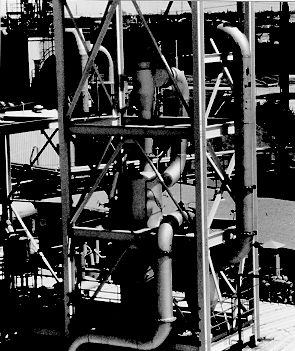
A pilot-scale combustor with a capacity of 6 tons per day has been constructed (see photograph), and testing has produced samples of agglomerated soil. Future testing will focus on sustained and continuous operation of the pilot-scale plant using different types of soil, as well as other feedstocks. Tests with organic and inorganic hazardous waste surrogates admixed with the feed soil will also be conducted. A final report on the project has been submitted to EPA.
AGGCOM Pilot Plant
EPA PROJECT MANAGER:
Teri Richardson
U.S. EPA
National Risk Management Research Laboratory
26 West Martin Luther King Drive
Cincinnati, OH 45268
513-569-7949
Fax: 513-569-7105
TECHNOLOGY DEVELOPER CONTACTS:
Amir Rehmat or Michael Mensinger
Institute of Gas Technology
1700 South Mount Prospect Road
Des Plaines, IL 60018-1804
847-768-0588 or 847-768-0602
Fax: 847-768-0516
E-mail: arehmat@igt.org or
mensing@igt.org