(Chemical and Biological Treatment)
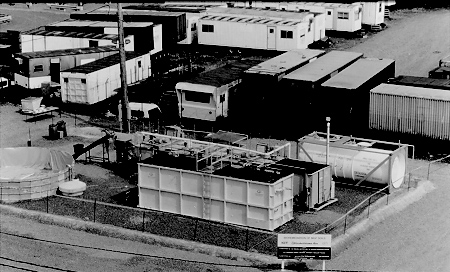
The Institute of Gas Technology (IGT) chemical and biological treatment (CBT) process remediates sludges, soils, groundwater, and surface water contaminated with organic pollutants, such as polynuclear aromatic hydrocarbons (PAH) and polychlorinated biphenyls (see photograph below). The treatment system combines two remedial techniques: (1) chemical oxidation as pretreatment, and (2) biological treatment using aerobic and anaerobic biosystems in sequence or alone, depending on the waste. The CBT process uses mild chemical treatment to produce intermediates that are biologically degraded, reducing the cost and risk associated with a more severe treatment process such as incineration.
Chemical and Biological Treatment Process
During the pretreatment stage, the contaminated material is treated with a chemical reagent that degrades the organics to carbon dioxide, water, and partially oxidized intermediates. In the second stage of the CBT process, biological systems degrade the hazardous residual materials and the partially oxidized intermediates from the first stage. Chemically treated wastes are subjected to cycles of aerobic and anaerobic degradation if aerobic or anaerobic treatment alone is not sufficient. Several cycles of chemical and biological treatment are also used for extremely recalcitrant contaminants.
The CBT process can be applied to soils, sludges, groundwater, and surface water containing (1) high waste concentrations that would typically inhibit bioremediation, or (2) low waste concentrations for which bioremediation alone is too slow. The process is not adversely affected by radionuclides or heavy metals. Depending on the types of heavy metals present, these metals will bioaccumulate in the biomass, complex with organic or inorganic material in the soil slurries, or solubilize in the recycled water.
The CBT process can be applied to a wide range of organic pollutants, including alkenes, chlorinated alkenes, aromatics, substituted aromatics, and complex aromatics.
IGT evaluated the CBT process for 2 years under the SITE Emerging Technology Program. The Emerging Technology Bulletin (EPA/540/F-94/540), which details results from the evaluation, is available from EPA. Based on results from the Emerging Technology Program, this technology was invited to participate in the SITE Demonstration Program.
Under the SITE Demonstration Program, IGT plans to conduct a full-scale demonstration of the CBT process on sediments containing PAHs. Different operating scenarios will be used to demonstrate how effectively the CBT process treats sediments in a bioslurry reactor. Several sites are being considered for the demonstration.
EPA PROJECT MANAGER:
Ronald Lewis
U.S. EPA
National Risk Management Research Laboratory
26 West Martin Luther King Drive
Cincinnati, OH 45268
513-569-7856
Fax: 513-569-7105
TECHNOLOGY DEVELOPER CONTACT:
Robert Kelley
Institute of Gas Technology
1700 South Mount Prospect Road
Des Plaines, IL 60018-1804
847-768-0722
Fax: 847-768-0546