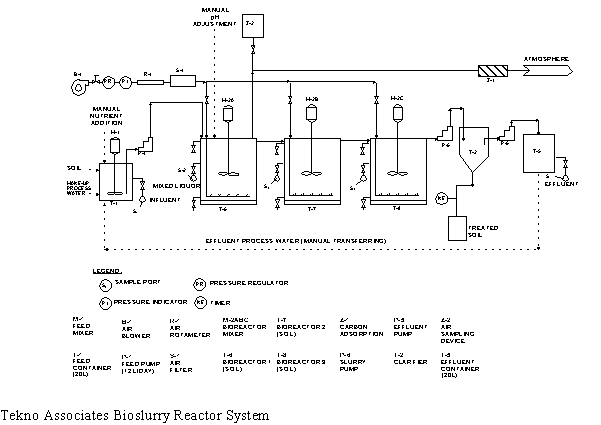
(Tekno Associates Bioslurry Reactor)
IT Corporation (IT) has used the Bioslurry Reactor (developed by Tekno Associates, Salt Lake City, Utah) to treat polynuclear aromatic hydrocarbons (PAH) in soil. Traditional biological treatments, such as landfarming and in situ bioremediation, may not reduce PAHs in soil to target levels in a timely manner. Slurry reactors are more efficient for bioremediation and more economical than thermal desorption and incineration.
During the project, IT operated one 10-liter and two 60-liter bioslurry reactors (see figure below) in semicontinuous, plug-flow mode. The first 60-liter reactor received fresh feed daily and supplements of salicylate and succinate.
Alicylate induces the naphthalene degradation operon on PAH plasmids in the microorganisms. This system has been shown to degrade phenanthrene and anthracene. The naphthalene pathway may also play a role in carcinogenic PAH (CPAH) metabolism. Succinate is a by-product of naphthalene metabolism and serves as a general carbon source.
The first 60-liter reactor removed easily degradable carbon and increased biological activity against more recalcitrant PAHs (three-ring compounds and higher).
Effluent from the first reactor overflowed to the second 60-liter reactor in series, where Fenton's reagent (hydrogen peroxide and iron salts) was added to accelerate oxidation for four- to six-ring PAHs. Fenton's reagent produces a free radical that can oxidize multi-ring aromatic hydrocarbons.
The T-8 reactor (third in a series) was used as a polishing reactor to remove any partially oxidized contaminants remaining after the Fenton's reagent treatment. Slurry was removed from this reactor and clarified using gravity settling techniques.
Operation of the reactors as described increased the rate and extent of PAH biodegradation, making bioslurry treatment of impacted soils and sludges a more effective and economical remediation option.
This technology is applicable to PAH-contaminated soils and sludges that can be readily excavated for slurry reactor treatment. Soils from coal gasification sites, wood-treating facilities, petrochemical facilities, and coke plants are typically contaminated with PAHs.
This technology was accepted into the SITE Emerging Technology Program in 1993. Under this program, IT conducted a pilot-scale investigation of the three slurry reactors operating in series. A suitable soil for the pilot-scale test was obtained from a wood-treating facility in the southeastern U.S. About 4,000 pounds of PAH-impacted soil was screened and treated during summer 1994. CPAH and PAH removals were demonstrated at 84 and 95 percent, respectively. A final report will be available from EPA in 1997.
EPA PROJECT MANAGER:
Brunilda Dávila
U.S. EPA
National Risk Management Research Laboratory
26 West Martin Luther King Drive
Cincinnati, OH 45268
513-569-7849
Fax: 513-569-7620
TECHNOLOGY DEVELOPER CONTACT:
Kandi Brown
IT Corporation
312 Directors Drive
Knoxville, TN 37923
423-690-3211
Fax: 423-690-3626