(Electrochemical Peroxidation of PCB-Contaminated Sediments and Waters)
The Environmental Research Center at the State University of New York at Oswego (SUNY) has developed an electrochemical peroxidation process widely applicable for the treatment of liquid wastes and slurries with low solids content. The process treats mixed waste by using (1) oxidative free radicals to attack organic contaminants, and (2) adsorptive removal of metals from liquid waste streams. Initial testing indicates destructive efficiencies greater than 99 percent for a variety of compounds including polychlorinated biphenyls (PCB), volatile organic compounds, benzene, toluene, ethylbenzene, xylene, organic dyes, and microbes.
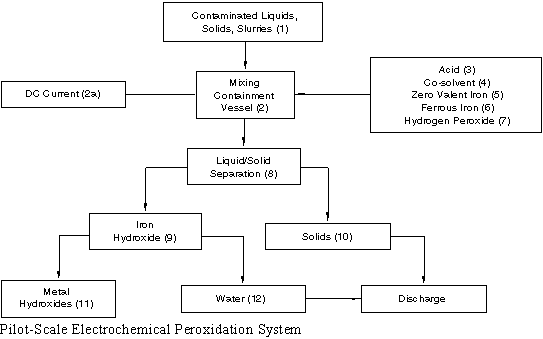
The process involves combining Fenton's reagent with a small electrical current. In a batch treatment process, steel electrodes are submersed into the waste to be treated; solid particles are suspended by mechanical mixing or stirring. A low direct current is applied to the electrodes, and hydrogen peroxide and a reduced form of iron are added. The iron and hydrogen peroxide instantaneously react to form free radicals, which oxidize organic contaminants. Free radicals are also produced by the reaction of the peroxide with solvated electrons. The process can be significantly enhanced by pH adjustment, periodic current reversal, and use of proprietary enhancements.
Metals readily adsorb to the iron hydroxide by-product, and the metals can then be separated by precipitation or flocculation. The volume of by-products may be reduced and the metals may be immobilized by heating and phase conversion to hematite. In specific applications, select metals may be plated onto electrodes and recovered.
This process is capable of treating liquids and slurries containing a variety of contaminants, including oxidizable organic compounds and metals. The process may be applied to industrial process wastes (textiles, pulp and paper, food industry), landfill leachates, gasoline- or solvent-contaminated groundwater, pesticide rinsates, or other liquid wastes.
The technology was accepted into the SITE Emerging Technology Program in November 1993 to evaluate photochemical methods of destroying PCBs in water and sediment. The evaluation was complete in 1995. An Emerging Technology Report will be available in late 1996.
During research related to the initial SITE evaluation, which focused on photocatalytic processes, a new technology (electrochemical peroxidation) was discovered. Electrochemical peroxidation has distinct advantages over photochemical processes, and its development was pursued. A pilot-scale continuous flow treatment system has been constructed with a local remediation firm and will be tested at a gasoline-contaminated groundwater site in spring 1997. If initial tests are encouraging, in situ application of the process will be conducted.
EPA PROJECT MANAGER:
Hector Moreno
U.S. EPA
National Risk Management Research Laboratory
26 West Martin Luther King Drive
Cincinnati, OH 45268
513-569-7882
Fax: 513-569-7879
TECHNOLOGY DEVELOPER CONTACTS:
Ronald Scrudato
Jeffrey Chiarenzelli
Environmental Research Center
319 Piez Hall
State University of New York at Oswego
Oswego, NY 13126
315-341-3639
Fax: 315-341-5346