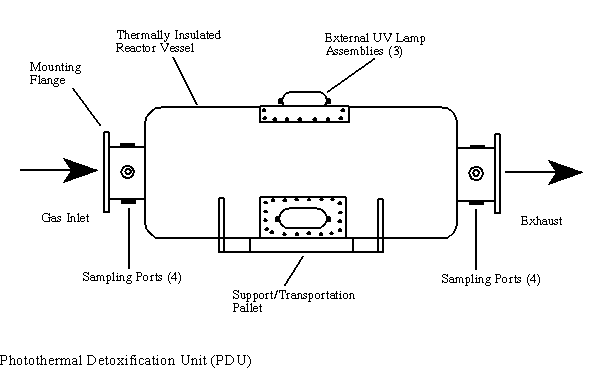
(Photothermal Detoxification Unit)
Photolytic reactions (reactions induced by exposure to ultraviolet [UV] light) can destroy certain hazardous organic wastes at relatively low temperatures. However, most photochemical processes offer relatively limited throughput rates and cannot completely mineralize the targeted wastes. For aqueous waste streams, these problems have been partially addressed by using indirect photochemical reactions involving a highly reactive photolytic initiator such as hydrogen peroxide or heterogeneous catalysts. Recently, the University of Dayton Research Institute (UDRI) developed a photolytic detoxification process to treat the gas waste streams. This process is clean and efficient and offers the speed and general applicability of a combustion process.
The photothermal detoxification unit (PDU) uses photothermal reactions conducted at temperatures higher than those used in conventional photochemical processes (200 to 500 °C versus 20 °C), but lower than combustion temperatures (typically greater than 1,000 °C). At these elevated temperatures, photothermal reactions are energetic enough to destroy many wastes quickly and efficiently without producing complex and potentially hazardous by-products.
The PDU is a relatively simple device, consisting of an insulated reactor vessel illuminated with high-intensity UV lamps. As shown in the figure below, the lamps are mounted externally for easy maintenance and inspection. Site remediation technologies that generate high-temperature gas streams, such as thermal desorption or in situ steam stripping, can incorporate the PDU with only slight equipment modifications. The PDU can be equipped with a pre-heater for use with soil vapor extraction (SVE). Furthermore, the PDU can be equipped with conventional air pollution control devices for removal of acids and suspended particulates from the treated process stream. The PDU shown in the figure below is also equipped with built-in sampling ports for monitoring and quality assurance and quality control.
According to UDRI, the PDU has proven extremely effective at destroying the vapors of polychlorinated biphenyls, polychlorinated dibenzodioxins, polychlorinated dibenzofurans, aromatic and aliphatic ketones, and aromatic and aliphalic chlorinated solvents, as well as brominated and nitrous wastes found in soil, sludges, and aqueous streams. The PDU can be incorporated with most existing and proposed remediation processes for clean, efficient, on-site destruction of the off-gases. More specifically, high-temperature processes can directly incorporate the PDU; SVE can use the PDU fitted with a preheater; and groundwater remediation processes can use the PDU in conjunction with air stripping.
The technology was accepted into the Emerging Technology Program in August 1992, and development work began in December 1992. The evaluation was completed in 1994. The Emerging Technology Report (EPA/540/R-95/526), the Emerging Technology Bulletin (EPA/540/F-95/505) and the Emerging Technology Summary (EPA/540/SR-95/526) are available from EPA. An article was also published in the Journal of Air and Waste Management, Volume 15, No. 2, 1995.
Emerging Technology Program data indicate that the technology performs as expected for chlorinated aromatic wastes, such as dichlorobenzene and tetrachlorodibenzodioxin, and better than expected for relatively light chlorinated solvents, such as trichloroethene (TCE) and tetrachloroethene. Further tests with selected mixtures, including benzene, toluene, ethyl-benzene, xylene, TCE, dichlorobenzene, and water vapor, show that the process is effective at treating wastes typically found at many remediation sites. Adequate scaling and performance data are now available to proceed with the design and development of prototype full-scale units for field testing and evaluation.
Through prior programs with the U.S. Department of Energy, technology effectiveness has been thoroughly investigated using relatively long wavelength UV light (concentrated sunlight with wavelengths greater than 300 nanometers). Limited data have also been generated at shorter wavelengths (higher energy) using available industrial UV illumination systems.
EPA PROJECT MANAGER:
Chien Chen
U.S. EPA
National Risk Management Research Laboratory
2890 Woodbridge Avenue, MS-104
Edison, NJ 08837-3679
908-906-6985
Fax: 908-321-6640
TECHNOLOGY DEVELOPER CONTACTS:
Barry Dellinger or John Graham
Environmental Sciences and Engineering Group
University of Dayton Research Institute
300 College Park
Dayton, OH 45469-0132
513-229-2846
Fax: 513-229-2503