(Adsorptive Filtration)
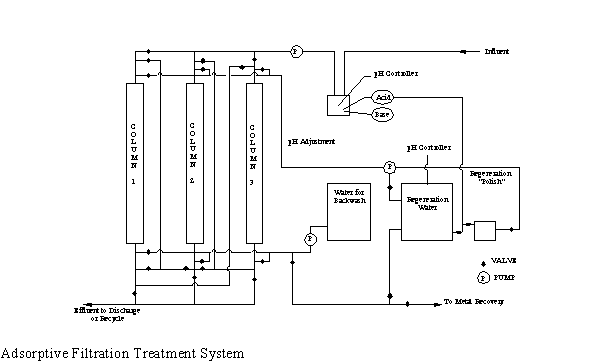
Adsorptive filtration removes inorganic contaminants (metals) from aqueous waste streams. An adsorbent ferrihydrite is applied to the surface of an inert substrate such as sand, which is then placed in one of three vertical columns (see figure below). The contaminated waste stream is adjusted to a pH of 9 to 10 and passed through the column. The iron-coated sand grains in the column act simultaneously as a filter and adsorbent. When the column's filtration capacity is reached (indicated by particulate breakthrough or column blockage), the column is backwashed. When the adsorptive capacity of the column is reached (indicated by break-through of soluble metals), the metals are removed and concentrated for subsequent recovery with a pH-induced desorption process.
Sand can be coated by ferrihydrite formed when either iron nitrate or iron chloride salts react with sodium hydroxide. The resulting ferrihydrite-coated sand is insoluble at a pH greater than 1; thus, acidic solutions can be used in the regeneration step to ensure complete metal recovery. The system does not appear to lose treatment efficiency after numerous regeneration cycles. Anionic metals such as arsenate, chromate, and selenite can be removed from the solution by treating it at a pH near 4 and regenerating it at a high pH. The system has an empty bed retention time of 2 to 5 minutes.
This technology offers several advantages over conventional treatment technologies. These advantages are its ability to (1) remove both dissolved and suspended metals from the waste stream, (2) remove a variety of metal complexes, (3) work in the presence of high concentrations of background ions, and (4) remove anionic metals.
This adsorptive filtration process removes inorganic contaminants, consisting mainly of metals, from aqueous waste streams. It can be applied to aqueous waste streams with a wide range of contaminant concentrations and pH values.
This technology was accepted into the SITE Emerging Technology Program in January 1988; the evaluation was completed in 1992. The Emerging Technology Report (EPA/540/R-93/515), Emerging Technology Summary (EPA/540/SR-93/515), and Emerging Technology Bulletin (EPA/540/F-92/008) are available from EPA.
During the SITE evaluation, synthetic solutions containing cadmium, copper, or lead at concentrations of 0.5 part per million (ppm) were treated in packed columns using 2-minute retention times. After approximately 5,000 bed volumes were treated, effluent concentrations were about 0.025 ppm for each metal, or a 95 percent removal efficiency. The tests were stopped, although the metals were still being removed. In other experiments, the media were used to adsorb copper from wastewater containing about 7,000 milligrams per liter (mg/L) copper.
The first batch of regenerant solutions contained cadmium and lead at concentrations of about 500 ppm. With initial concentrations of 0.5 ppm, this represents a concentration factor of about 1,000 to 1. Data for the copper removal test have not been analyzed. At a flow rate yielding a 2-minute retention time, the test would have taken about 7 days of continuous flow operation to treat 5,000 bed volumes. Regeneration took about 2 hours.
The system has also been tested for treatment of rinse waters from a copper-etching process at a printed circuit board shop. The coated sand was effective in removing mixtures of soluble, complexed, and particulate copper, as well as zinc and lead, from these waters. When two columns were used in series, the treatment system was able to handle fluctuations in influent copper concentration from less than 10 mg/L up to several hundred mg/L.
Groundwater from Western Processing, a Superfund site near Seattle, Washington, was treated to remove both soluble and particulate zinc.
EPA PROJECT MANAGER:
Norma Lewis
U.S. EPA
National Risk Management Research Laboratory
26 West Martin Luther King Drive
Cincinnati, OH 45268
513-569-7665
Fax: 513-569-7787
TECHNOLOGY DEVELOPER CONTACT:
Mark Benjamin
University of Washington
Department of Civil Engineering
P.O. Box 352700
Seattle, WA 98195-2700
206-543-7645
Fax: 206-685-9185