(In Situ Mitigation of Acid Water)
The in situ acid water mitigation process addresses the acid drainage problem associated with exposed sulfide-bearing minerals from sources including mine waste rock and abandoned metallic mines. Acid drainage forms under natural conditions when iron disulfides are exposed to the atmosphere and water, spontaneously oxidizing them to produce a complex of highly soluble iron sulfates and salts. These salts hydrolyze to produce an acid-, iron-, and sulfate-enriched drainage that adversely affects the environment.
The in situ mitigation strategy modifies the hydrology and geochemical conditions of the site through land surface reconstruction and selective placement of limestone.
Limestone is used as the alkaline source material because it has long-term availability, is generally inexpensive, and is safe to handle. For the chemical balances to be effective, the site must receive enough rainfall to produce seeps or drainages that continually contact the limestone. Rainfall, therefore, helps to remediate the site, rather than increasing the acid drainage.
During mine construction, lysimeters and limestone chimneys are installed to collect surface runoff and funnel it into the waste rock dump. Acidic material is capped with impermeable material to divert water from the acid cores. This design causes the net acid load to be lower than the alkaline load, resulting in benign, nonacid drainage.
The technology mitigates acid drainage from abandoned waste dumps and mines. It can be applied to any site in a humid area where limestone is available.
This technology was accepted into the SITE Emerging Technology Program in March 1990. Studies under the Emerging Technology Program are complete. A peer-reviewed journal article has been prepared and submitted.
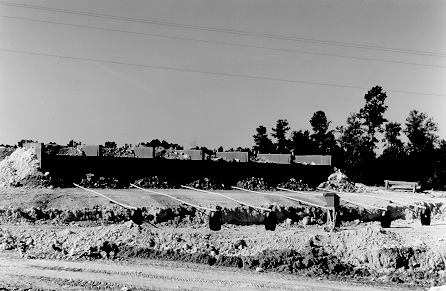
For the SITE evaluation, six large-scale lysimeters (12 feet wide, 8 feet high, and 16 feet deep) were constructed and lined with 20-mil polyvinyl chloride plastic (see photograph on previous page). The lysimeters drained through an outlet pipe into 55-gallon collection barrels. Piezometers in the lysimeter floor monitored the hydrology and chemistry of the completed lysimeter. During June 1991, 50 tons of acid-producing mine waste rock was packed into each lysimeter.
The effluent from each lysimeter was monitored for 1 year to establish a quality baseline. In the second phase of the study, selected lysimeters were topically treated, maintaining two lysimeters as controls to compare the efficacy of the acid abatement strategy. In addition, a rain gauge was installed at the site for mass balance measurements. An ancillary study correlating laboratory and field results is complete.
In the last phase of the 3-year study, little if any leachate was collected due to drought conditions in the southeast U.S. With the return of normal rainfall, sufficient leachate was collected to compare the treated lysimeters against the controls to evaluate the treatment's effectiveness. The treated lysimeters, in general, showed a 20 to 25 percent reduction in acid formation. The acidities measured about 10,000 milligrams per liter (mg/L) for the untreated lysimeters, while acidities from the treated lysimeters measured about 7,000 mg/L. This study was conducted on a very high acid-producing waste rock, representing a near worst-case situation. The process should be more successful on milder acid sources.
Overview of Site Lysimeters
EPA PROJECT MANAGER:
Roger Wilmoth
U.S. EPA
National Risk Management Research Laboratory
26 West Martin Luther King Drive
Cincinnati, OH 45268
513-569-7509
Fax: 513-569-7787
TECHNOLOGY DEVELOPER CONTACT:
Frank Caruccio
Department of Geological Sciences
University of South Carolina
Columbia, SC 29208
803-777-4512
Fax: 803-777-6610