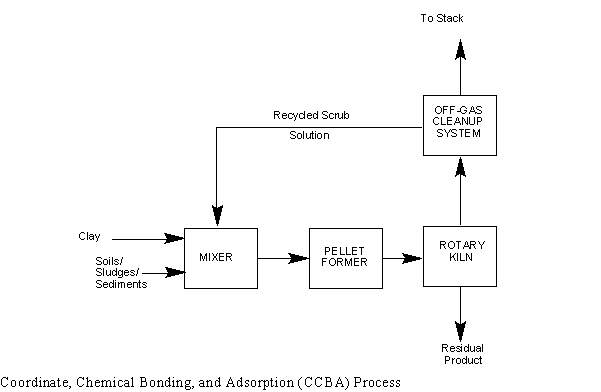
(Coordinate, Chemical Bonding, and Adsorption Process)
The coordinate, chemical bonding, and adsorption (CCBA) process converts heavy metals in soils, sediments, and sludges to nonleaching silicates. The process can also oxidize organics in the waste stream and incorporate the ash into the ceramic pellet matrix (see figure below). The solid residual consistency varies from a soil and sand density and size distribution to a controlled size distribution ceramic aggregate form. The residue can be placed back in its original location or used as a substitute for conventional aggregate. The process uses clays with specific cation exchange capacity as sites for physical and chemical bonding of heavy metals to the clay.
The process is designed for continuous flow. The input sludge and soil stream are carefully ratioed with specific clays and then mixed in a high-intensity mechanical mixer. The mixture is then densified and formed into green or unfired pellets of a desired size. The green pellets are then direct-fired in a rotary kiln for approximately 30 minutes. The pellet temperature slowly rises to 2,000°F, converting the fired pellet to the ceramic state. Organics on the pellet's surface are oxidized, and organics inside the pellet are pyrolyzed as the temperature rises. As the pellets reach 2,000°F, the available silica sites in the clay chemically react with the heavy metals in the soil and sludge to form the final metal silicate product.
The process residue is an inert ceramic product, free of organics, with metal silicates providing a molecular bonding structure that precludes leaching. The kiln off-gas is processed in an afterburner and wet scrub system before it is released into the atmosphere. Excess scrub solution is recycled to the front-end mixing process.
The CCBA process has been demonstrated commercially on metal hydroxide sludges at a throughput of 70 wet tons per month, based on an 8-hour day, for a 25 percent solid feed. This process can treat wastewater sludges, sediments, and soils contaminated with most mixed organic and heavy metal wastes.
The CCBA process was accepted into the SITE Emerging Technology Program in January 1991. Under this program, the CCBA technology has been modified to include soils contaminated with both heavy metals and most organics. The SITE studies were completed at a pilot facility with a capacity of 10 pounds per hour. Proof tests using contaminated soil have been completed. The Emerging Technology Report, Emerging Technology Summary, and Emerging Technology Bulletin will be available from EPA in early 1997.
EPA PROJECT MANAGER:
Vince Gallardo
U.S. EPA
National Risk Management Research Laboratory
26 West Martin Luther King Drive
Cincinnati, OH 45268
513-569-7176
Fax: 513-569-7620
TECHNOLOGY DEVELOPER CONTACTS:
Donald Kelly
Western Product Recovery Group, Inc.
P.O. Box 79728
Houston, TX 77279
713-533-9321
Fax: 713-533-9434
Bert Elkins
Western Product Recovery Group, Inc.
10626 Cerveza Drive
Escondido, CA 92026
619-749-8856
Fax: 619-749-8856