EG&G ENVIRONMENTAL, INC.
(NoVOCs™ In-Well Stripping Technology)
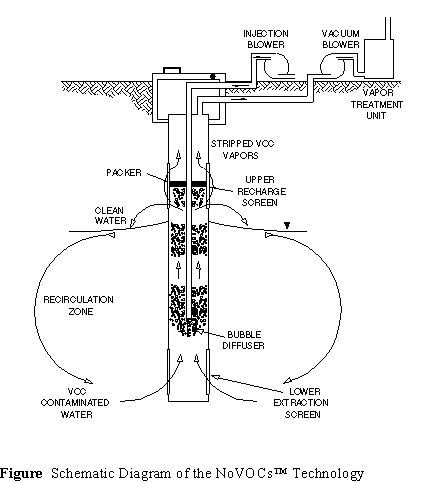
EG&G Environmental, Inc., has developed the patented NoVOCs™ in-well stripping technology for the in situ removal of volatile organic compounds (VOC) from groundwater (see figure below). NoVOCs™ combines air-lift pumping with in-well vapor stripping to remove VOCs from groundwater without the need to remove, treat, and discharge a wastewater stream. The process can also be adapted to remove both VOCs and soluble metals from groundwater.
NoVOCs™ consists of a well screened both beneath the water table and in the vadose zone. An air line within the well runs from an aboveground blower and extends below the watertable. Pressurized air injected below the watertable aerates the water within the well, creating a density gradient between the aerated water and the more dense water in the surrounding aquifer. As a result, dense water flows in through the lower well screen and forces the aerated water upward within the well, while becoming aerated itself. The result is a rising column of aerated water within the well, or an air-lift pump.
As the aerated groundwater column rises within the well, VOC mass transfer occurs from the dissolved phase to the vapor phase. Above the water table, a packer is installed at the upper screen to prevent the passage of rising water or bubbles. The rising water column hits the packer, the bubbles burst and the entrained VOC vapor is stripped off laterally through the screen by an upper vacuum casing. The VOC-rich vapor is brought to the surface for treatment while the laterally deflected water circulates back into the aquifer. Reinfiltrating water creates a toroidal circulation pattern around the well, enabling the groundwater to undergo multiple treatment cycles before flowing downgradient. The VOC-rich vapor is treated using commercially available techniques chosen according to the vapor stream characteristics.
NoVOCs™ can also be used to remove readily reduced metals from groundwater and stabilize them in the vadose zone. Solubilized metals in their oxidized states enter the lower screen by the same route as dissolved VOCs in the groundwater. The nonvolatile metals remain in solution as the VOCs are stripped at the upper screen and the water circulates out of the well. The groundwater and soluble metals then pass through an infiltration and treatment gallery surrounding the upper well screen. This treatment gallery is impregnated with a reducing agent which reduces the soluble metals to an insoluble valence state. The insoluble metals accumulate in the infiltration gallery high above the water table and can be either capped or excavated at the conclusion of remedial action.
The process treats groundwater contaminated by volatile petroleum hydrocarbons including benzene, ethylbenzene, and toluene, as well as chlorinated solvents such as tetrachloroethene and trichloroethene. Highly soluble organics like alcohols and ketones are not easily air-stripped from water but are readily biodegraded in the oxygen-rich environment produced by NoVOCs™.
The NoVOCs™ technology was accepted into the SITE Demonstration Program in 1995. The demonstration is scheduled to occur at Naval Air Station North Island in San Diego, California. The demonstration is on hold awaiting a Research Conservation and Recovery Act permit.
EPA PROJECT MANAGER:
Michelle Simon
U.S. EPA
National Risk Management Research
Laboratory
26 West Martin Luther King Drive
Cincinnati, OH 45268
513-569-7469
Fax: 513-569-7676
TECHNOLOGY DEVELOPER CONTACT:
James Beninati
EG&G Environmental, Inc.
Foster Plaza 6, Suite 400
681 Andersen Drive
Pittsburgh, PA 15220
412-920-5401
Fax: 412-920-5402