(Lasagna™ In Situ Soil Remediation)
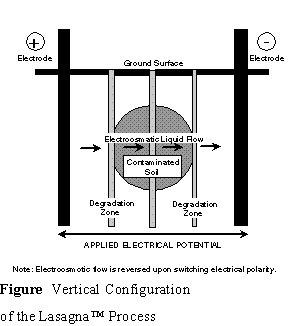
The Lasagna™ process, so named because of its treatment layers, combines electroosmosis with treatment layers which are installed directly into the contaminated soil to form an integrated, in situ remedial process. The layers may be configured vertically (Figure 1) or horizontally (Figure 2). The process is designed to treat soil and groundwater contaminants completely in situ, without the use of injection or extraction wells.
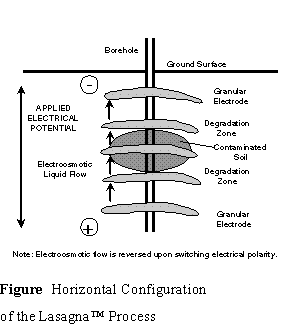
The outer layers consist of either positively or negatively charged electrodes. An electric field is created by the electrodes, and the electric field created by the electrodes moves contaminants in soil pore fluids into or through the treatment layers. In the vertical configuration, steel rods, may be used as electrodes. In the horizontal configuration, the electrodes and treatment zones are installed by hydraulic fracturing. Granular graphite is used for the electrodes and the treatment zones are granular iron (for zero-valent, metal-enhanced, reductive dechlorination) or granular activated carbon (for biodegradation by methanotrophic microorganisms).
The Lasagna™ process can remove contaminants from soil in three ways:
The orientation of the electrodes and treatment zones depends on the characteristics of the site and the contaminants. In general, the vertical configuration is probably applicable to more shallow contamination, within 50 feet of the ground surface. The horizontal configuration, using hydraulic fracturing or related methods, is uniquely capable of treating much deeper contamination.
Conceptually, the Lasagna™ process is designed to treat organic and inorganic contaminants and mixed wastes in groundwater and soil. To date, the process has been tested primarily on organic contaminants in low permeability soils.
The Lasagna™ process (vertical configuration) was accepted into the SITE Demonstration Program in 1995. The horizontal configuration is not being evaluated by the SITE Demonstration Program because the work is being conducted by EPA employees in conjunction with the University of Cincinnati. EPA is conducting work on the horizontal configuration under a cooperative research and development agreement with a private research consortium consisting of Monsanto, DuPont, and General Electric. This collaborative effort between the federal government and industry is a result of an action team of the Remediation Technologies Development Forum (RTDF). The RTDF identifies ways that the federal government can work with private industry to solve complex contamination problems at hazardous waste sites.
Under the SITE Program, with significant funding from the U.S. Department of Energy (DOE), the Lasagna™ process was tested for 120 days in May 1995 on soil contaminated with trichloroethene (TCE) at DOE's Paducah Gaseous Diffusion Plant (PGDP) in Kentucky. One of the key objectives of this test was to successfully demonstrate the coupling of elecroosmotic flushing of TCE from the clay soil while removing the TCE from the pore water by in situ adsorption. Steel panels were used as electrodes and granular activated carbon served as treatment layers in a vertical configuration.
Sampling and analysis of the carbon at the end of the test revealed a substantial amount of TCE. Soil samples collected before and after the test indicated a 98 percent removal of TCE from tight clay soil, with some samples showing greater than 99 percent removal. TCE soil levels were reduced from the 100 parts per million (ppm) range to an average concentration of 1 ppm.
A second test of the Lasagna™ process in a vertical configuration is underway on larger volumes of soil at DOE's PGDP under the Rapid Commercialization Initiative (RCI). RCI was created by the Department of Commerce, Department of Defense, Department of Energy, and EPA to assist in the integration of innovative technologies into the marketplace.
EPA and the University of Cincinnati have installed horizontal configuration cells at Rickenbacker Air National Guard Base (ANGB) near Columbus, OH. Support facilities are being installed at Offutt Air Force Base (AFB) near Omaha, NE. Horizontal configuration cells will be installed at Offutt AFB in spring 1997 with funding support form the U.S. Air Force. TCE is the target contaminant at both Rickenbacker ANGB and Offutt AFB.
EPA PROJECT MANAGER:
Ronald Turner or Michelle Simon
U.S. EPA
National Risk Management Research
Laboratory
26 West Martin Luther King Drive
Cincinnati, OH 45268
513-569-7775 or 513-569-7469
Fax: 513-569-7676
TECHNOLOGY DEVELOPER CONTACT:
Michael Roulier
U.S. EPA
National Risk Management Research Laboratory
26 West Martin Luther King Drive
Cincinnati, OH 45268
513-569-7796
Fax: 513-569-7620
Sa Ho
Monsanto Company
800 N. Lindbergh Boulevard
St. Louis, MO 63167
314-694-5179
Fax: 314-694-8080