(Bioventing)
Lack of oxygen in contaminated soil often limits aerobic microbial growth. The bioventing biological system treats contaminated soil in situ by injecting atmospheric air. This air provides a continuous oxygen source, which enhances the growth of microorganisms naturally present in the soil. Additives such as ozone or nutrients may be introduced to stimulate microbial growth.
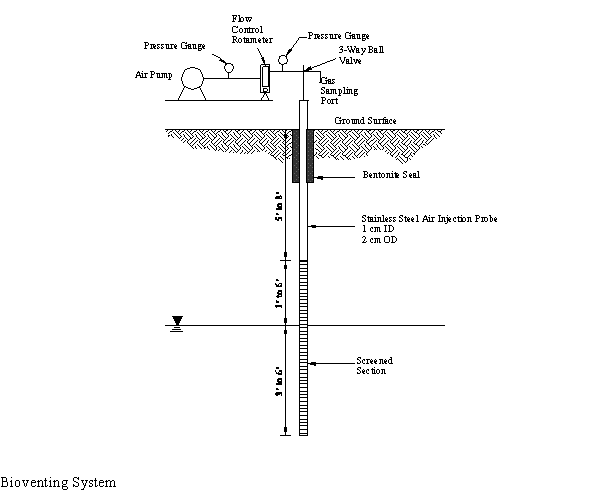
Bioventing technology uses an air pump attached to one of a series of air injection probes (see figure below). The air pump operates at extremely low pressures, providing inflow of oxygen without significantly volatilizing soil contaminants. The treatment capacity depends on the number of injection probes, the size of the air pump, and site characteristics such as soil porosity.
Bioventing is typically used to treat soil contaminated by industrial processes and can treat any contamination subject to aerobic microbial degradation. Bioventing treats contaminants and combinations of contaminants with varying degrees of success.
This technology was accepted into the SITE Demonstration Program in July 1991. The demonstration began in November 1992 at the Reilly Tar site in St. Louis Park, Minnesota. Soil at this site is contaminated with polynuclear aromatic hydrocarbons. The project will be completed in November 1997.
EPA PROJECT MANAGER:
Jack Hubbard
U.S. EPA
National Risk Management Research Laboratory
26 West Martin Luther King Drive
Cincinnati, OH 45268
513-569-7507
Fax: 513-569-7620
TECHNOLOGY DEVELOPER CONTACT:
Paul McCauley
U.S. EPA
National Risk Management Research Laboratory
26 West Martin Luther King Drive
Cincinnati, OH 45268
513-569-7444
Fax: 513-569-7105