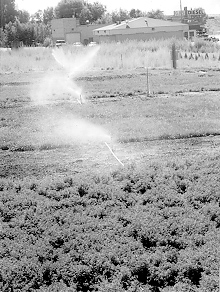
(Phytoremediation Process)
Phytoremediation is the treatment of contaminated soils, sediments, and groundwater with higher plants. Several biological mechanisms are involved in phytoremediation. The plant's ability to enhance bacterial and fungal degradative processes is important in the treatment of soils. Plant-root exudates, which contain nutrients, metabolites, and enzymes, contribute to the stimulation of microbial activity. In the zone of soil closely associated with the plant root (rhizosphere), expanded populations of metabolically active microbes can biodegrade organic soil contaminants.
The application of phytoremediation involves characterizing the site and determining the proper planting strategy to maximize the interception and degradation of organic contaminants. Site monitoring ensures that the planting strategy is proceeding as planned. The following text discusses (1) using grasses to remediate surface soils contaminated with organic chemical wastes, and (2) planting dense rows of poplar trees to treat organic contaminants in the saturated groundwater zone.
Soil Remediation - Phytoremediation is best suited for surface soils contaminated with intermediate levels of organic contaminants. Preliminary soil phytotoxicity tests are conducted at a range of contaminant concentrations to select plants which are tolerant. The contaminants should be relatively nonleachable, and must be within the reach of plant roots. Greenhouse-scale treatability studies are often used to select appropriate plant species.
Grasses are frequently used because of their dense fibrous root systems. The selected species are planted, soil nutrients are added, and the plots are intensively cultivated. Plant shoots are cut during the growing season to maintain vegetative, as opposed to reproductive, growth. Based on the types and concentrations of contaminants, several growing seasons may be required to meet the site's remedial goals.
Groundwater Remediation - The use of poplar trees for the treatment of groundwater relies in part on the tree's high rate of water use to create a hydraulic barrier. This technology requires the establishment of deep roots that use water from the saturated zone. Phytokinetics uses deep-rooted, water-loving trees such as poplars to intercept groundwater plumes and reduce contaminant levels. Poplars are often used because they are phreatophytic; that is, they have the ability to use water directly from the saturated zone.
A dense double or triple row of rapidly growing poplars is planted downgradient from the plume, perpendicular to the direction of groundwater flow. Special cultivation practices are use to induce deep root systems. The trees can create a zone of depression in the groundwater during the summer months because of their high rate of water use. Groundwater contaminants may tend to be stopped by the zone of depression, becoming adsorbed to soil particles in the aerobic rhizosphere of the trees. Reduced contaminant levels in the downgradient groundwater plume would result from the degradative processes described above.
Phytoremediation is used for soils, sediments, and groundwater containing intermediate levels of organic contaminants.
This technology was accepted into the SITE Demonstration Program in 1995. The demonstration will occur at the former Chevron Terminal #129-0350 site in Ogden, Utah. This demonstration will assess the ability of higher plants to reduce the concentration of petroleum hydrocarbons in near-surface soils, and to modify the groundwater gradient and reduce petroleum hydrocarbons in the saturated zone. Alfalfa and fescue plantings will be evaluated for soil remediation, while poplar and juniper trees will be investigated for their ability to treat the saturated groundwater zone.
The primary objectives of the demonstration are to determine whether (1) total petroleum hydrocarbon concentrations in the soil in plots planted with alfalfa and fescue will be reduced by 30 percent annually, and (2) an average annual 3-inch change in the groundwater elevation can be attributed to the trees. The demonstration is scheduled for the 1997 and 1998 growing seasons.
Phytoremediation of Surface Soils
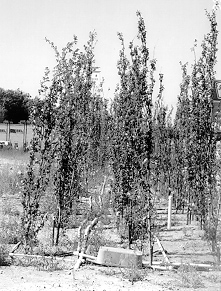
Phytoremediation of Saturated Zone
EPA PROJECT MANAGER:
Steven Rock
U.S. EPA
National Risk Management Research
Laboratory
26 West Martin Luther King Drive
Cincinnati, Ohio 45268
513-569-7149
Fax: 513-569-7105
TECHNOLOGY DEVELOPER CONTACT:
Ari Ferro
Phytokinetics, Inc.
1770 North Research Park Way
Suite 110
North Logan, UT 84341-1941
801-750-0985
801-755-0891
Fax: 801-750-6296