(Photolytic Destruction of Vapor-Phase Halogens)
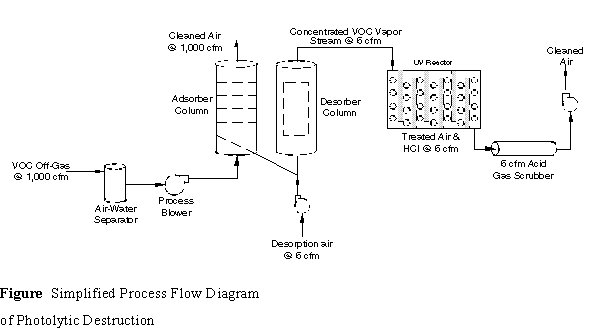
The proprietary, nonthermal technology developed by Process Technologies, Inc. (PTI), is a method of photochemically oxidizing gaseous organic compounds within a reaction chamber. PTI's Photolytic Destruction Technology (PDT) uses low-pressure ultraviolet (UV) lamps, with UV emissions primarily at wavelengths in the 185 to 254 nanometer range, located within the reaction chamber. Photons emitted from these lamps break apart the chemical bonds making up the volatile organic compound (VOC) molecule. The process is capable of destroying mixtures of chlorinated and nonchlorinated VOCs.
PTI uses a proprietary reagent that forms a liner within the process chamber. The reagent reacts chemically with the gaseous degradation products formed during the photolytic destruction of halocarbon molecules to form solid, stable reaction products.
Reagent lifetime depends on flow rate, influent concentrations, and specific chemical composition of destruction targets. PTI has performed tests on spent reagent to determine whether the material would be classified as a hazardous waste under the federal hazardous waste law and EPA regulations. Those tests indicated that the spent reagent is likely nontoxic. The spent reagent is also not reactive, corrosive, or flammable, and thus PTI is confident that it is not a hazardous waste under federal law. PTI accordingly believes that the spent reagent material can be disposed of as ordinary solid waste or used as a feedstock for cement manufacturing.
The technology was developed to destroy a number of families of compounds, including chlorinated solvents, chlorofluocarbons (CFCs), hydrochlorofluocarbons (HCFCs), and halons. Example sources of process off-gas include steam vapor extraction, tank vents, air strippers, steam strippers, and building vent systems.
The PDT system is designed and fabricated in 3- to 12-cubic-feet-per-minute (cfm) modules. The size of the module applied is dependent on the gas flow rate and VOC concentrations in the gas stream. The process is capable of destroying as high as 50,000 parts per million by volume (ppmv) VOC streams. PTI implements a fluid bed concentrator to allow for the treatment of high flow gas streams, or those with rates greater than 1,000 cfm. Significant cost savings can be realized if the gas flow can be reduced, and concentration increased prior to destruction.
The PTI process is simple in design and there are no moving parts. The system is capable of achieving greater than 90 percent on-line availability, inclusive of scheduled maintenance activities. The system is designed to run continuously, 24 hours per day.
The PTI technology was accepted into the SITE Demonstration Program in summer 1994. The demonstration began in September 1994 at McClellan Air Force Base (AFB) in Sacramento, California. The SITE demonstration was postponed shortly thereafter. Activities under the SITE Program will be rescheduled in 1997. Additional tests incorporating an improved design for treating soil vapor extraction off-gas were successfully completed at the AFB in January 1996.
PTI completed a successful 6-month treatability study at Hill AFB in Ogden, Utah. The purpose of the demonstration was to determine the effectiveness and commercial feasibility of the PDT in treating the high concentration, low flow, VOC-contaminated off-gases from the process tank vents in the facility. Process performance was compared directly to the standard treatment technology, granular activated carbon. A commercial system was installed in February 1996.
PTI completed a successful short-term, treatability study at Aerojet's Site 19F in May. Aerojet manufactures motors for liquid rockets and other defense-related equipment. This study was performed to evaluate the effectiveness and cost to remove and destroy trichloroethene (TCE) vapor from the existing extraction wells using the PDT. The results of this test showed that the PDT was able to destroy TCE at levels greater than 99 percent and at a cost less than activated carbon. PTI is now in discussions with Aerojet to supply the necessary equipment to remediate other known TCE plumes at the site.
EPA PROJECT MANAGER:
Paul de Percin
U.S. EPA
National Risk Management Research Laboratory
26 West Martin Luther King Drive
Cincinnati, OH 45268
513-569-7797
Fax: 513-569-7105
E-Mail:
dePercin.Paul@epamail.epa.gov
TECHNOLOGY DEVELOPER CONTACT:
Mike Swan
Process Technologies, Inc.
P.O. Box 476
Boise, ID 83701-0476
208-385-0900
Fax: 208-385-0994
TECHNOLOGY USER CONTACT:
Phil Mook
SM-ALC/EMR
5050 Dudley Boulevard
Suite 3
McClellan AFB, CA 95652-1389
916-643-5443
Fax: 916-643-0827
E-mail:
mook.phil@sma1.mcclellan.af.mil