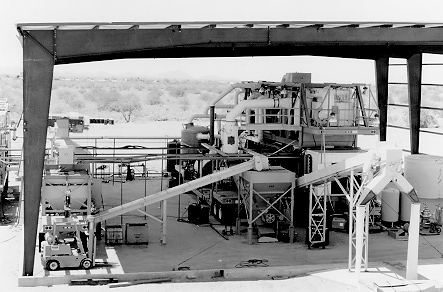
(Desorption and Vapor Extraction System)
The mobile desorption and vapor extraction system (DAVES) uses a low-temperature fluidized bed to remove organic and volatile inorganic compounds from soils, sediments, and sludges. This system can treat materials with 85 percent solids at a rate of 10.5 tons per hour.
Contaminated materials are fed into a co-current, fluidized bed dryer, where they are mixed with hot air (about 1,000 to 1,400 °F) from a gas-fired heater. Direct contact between the waste material and the hot air forces water and contaminants from the waste into the gas stream at a relatively low fluidized-bed temperature (about 320 °F). The heated air, vaporized water and organics, and entrained particles flow out of the dryer to a gas treatment system.
The gas treatment system removes solid particles, vaporized water, and organic vapors from the air stream. A cyclone separator and baghouse remove most of the particulates. Vapors from the cyclone separator are cooled in a venturi scrubber, countercurrent washer, and chiller section before they are treated in a vapor-phase carbon adsorption system. The liquid residues from the system are centrifuged, filtered, and passed through two activated carbon beds arranged in series (see photograph below).
Desorption and Vapor Extraction System (DAVES)
By-products from the DAVES include (1) treated, dry solid representing about 96 to 98 percent of solid waste feed, (2) a small quantity of centrifuge sludge containing organics, (3) a small quantity of spent adsorbent carbon, (4) wastewater that may need further treatment, and (5) small quantities of baghouse and cyclone dust that are recycled through the process.
The centrifuge sludge can be bioremediated, chemically degraded, or treated in another manner. Recycling Sciences International, Inc., has patented an electrochemical oxidation process (ECO) and is developing this process as an adjunct to the DAVES. The ECO is designed to detoxify contaminants within the DAVES in a closed-loop system.
This technology removes from soil, sludge, and sediment volatile and semivolatile organics, including polychlorinated biphenyls (PCB), polynuclear aromatic hydrocarbons, pentachlorophenol, volatile inorganics (such as tetraethyl lead), and some pesticides. In general, the process treats waste containing less than 10 percent total organic contaminants and 30 to 95 percent solids. The presence of nonvolatile inorganic contaminants (such as metals) in the waste feed does not inhibit the process; however, these contaminants are not treated.
This technology was accepted into the SITE Program in April 1995. EPA is selecting a demonstration site for this process. Preferred demonstration wastes include harbor or river sediments containing at least 50 percent solids and contaminated with PCBs and other volatile or semivolatile organics. Soils with these characteristics may also be acceptable. About 300 tons of waste is needed for a 2-week test. Major test objectives are to evaluate feed handling, decontamination of solids, and treatment of gases generated by the process.
EPA PROJECT MANAGER:
Richard Eilers
U.S. EPA
National Risk Management Research
Laboratory
26 West Martin Luther King Drive
Cincinnati, OH 45268
513-569-7809
Fax: 513-569-7111
TECHNOLOGY DEVELOPER CONTACT:
William Meenan
Recycling Sciences International, Inc.
175 West Jackson Boulevard
Suite A1934
Chicago, IL 60604-2601
312-663-4242
Fax: 312-663-4269