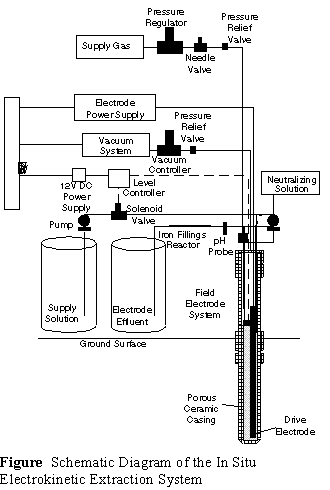
(In Situ Electrokinetic Extraction System)
Electrokinetic remediation has been used successfully to treat saturated soils contaminated with heavy metals. At some sites, however, it may not be desirable to add the quantities of water needed to saturate a contamination plume in the vadose zone. Sandia National Laboratories (SNL) has developed an electrokinetic remediation technology that can be used in unsaturated soils without adding significant amounts of water.
The SNL electrokinetic extraction system, shown in the figure below, consists of three main units: the electrode assembly (electrode casing and internal assemblies), the vacuum system, and the power supply. The electrode casing consists of a porous ceramic end that is 5 to 7 feet long and has an outer diameter of 3.5 inches. During field installation, the casing is attached to the required length of 3-inch polyvinyl chloride pipe. The electrode internal assembly consists of the drive electrode, a water level control system, and a pump system. The vacuum system consists of a venturi vacuum pump and vacuum regulator that together supply a constant vacuum for the electrode. Up to four 10,000-watt power supplies can operate in either constant voltage or constant current mode.
When the drive electrode is energized, contaminants and other ions are attracted into the electrode casing. The water level control system adds water to, and extracts water from, the electrodes. Water is supplied to the electrode from a supply solution tank at the ground surface. This solution is either drawn into the electrode by the vacuum maintained in the electrode or by a supply pump. At the same time, water is continuously pumped out from the electrode casing at a constant rate. Part of the contaminated water is sent to an effluent waste tank at the ground surface; the remainder is returned to the electrode to maintain circulation of the fluid surrounding the electrode. A metering pump controlled by in-line pH meters regulates the introduction of neutralization chemicals to each electrode. Process control and monitoring equipment is contained in a 10-foot- by-40-foot instrument trailer.
SNL has developed its electrokinetic extraction system to treat anionic heavy metals such as chromate in unsaturated soil. There is no lower limit to the contaminant concentration that can be treated; however, there may be a lower limit on the ratio of contaminant ions to other ions in the soil.
The technology can be expanded to treat saturated soils. Soil that is highly conductive because of a high salinity content is not suitable for this technology. In addition, sites with buried metal debris, such as pipelines, are not appropriate.
This technology was accepted into the SITE Demonstration Program in summer 1994. The SITE demonstration began May 1996, at an unlined chromic acid pit within a SNL landfill. The demonstration is scheduled for completion in January 1997.
Recent bench-scale studies at SNL have shown the technology to be effective in sandy soils with a moisture content as low as 7 percent. Field testing is underway to characterize in situ electrokinetic extraction of chromate contamination from unsaturated soils at the SNL chemical waste landfill. These tests are intended to show the technology's effectiveness in achieving in situ water control in unsaturated soil and to track the movement of chromate contamination.
EPA PROJECT MANAGER:
Randy Parker
U.S. EPA
National Risk Management Research Laboratory
26 West Martin Luther King Drive
Cincinnati, OH 45268
513-569-7271
Fax: 513-569-7571
TECHNOLOGY DEVELOPER CONTACTS:
Eric Lindgren
Sandia National Laboratories
Mail Stop 0719
P.O. Box 5800
Albuquerque, NM 87185-0719
505-844-3820
Fax: 505-844-0543
E-mail: erlindg@sandia.gov
Earl D. Mattson
Sat-UnSat Inc.
12004 Del Rey NE
Albuquerque, NM 87122
505-856-3311