(Contained Recovery of Oily Wastes)
The contained recovery of oily wastes (CROW®) process recovers oily wastes from the ground by adapting a technology used for secondary petroleum recovery and primary production of heavy oil and tar sand bitumen. Steam or hot water displacement moves accumulated oily wastes and water to production wells for aboveground treatment.
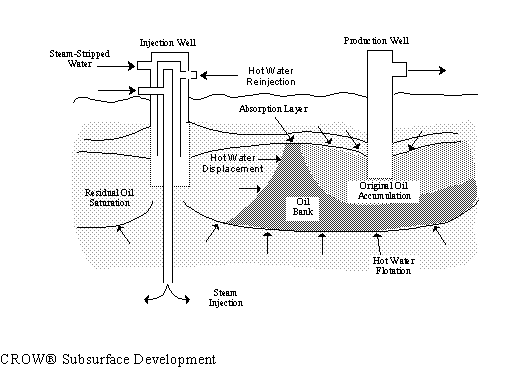
Injection and production wells are first installed in soil contaminated with oily wastes (see figure below). If contamination has penetrated into or below the aquifer, low-quality steam can be injected below the organic liquids to dislodge and sweep them upward into the more permeable aquifer soil regions. Hot water is injected above the impermeable regions to heat and mobilize the oily waste accumulation. The mobilized wastes are then recovered by hot water displacement.
When the organic wastes are displaced, organic liquid saturation in the subsurface pore space increases, forming a free-fluid bank. The hot water injection displaces the free-fluid bank to the production well. Behind the free-fluid bank, the contaminant saturation is reduced to an immobile residual saturation in the subsurface pore space. The extracted contaminant and water are treated for reuse or discharge.
During treatment, all mobilized organic liquids and water-soluble contaminants are contained within the original boundaries of waste accumulation. Hazardous materials are contained laterally by groundwater isolation and vertically by organic liquid flotation. Excess water is treated in compliance with discharge regulations.
The CROW® process removes large portions of contaminant accumulations; stops the downward and lateral migration of organic contaminants; immobilizes any remaining organic wastes as a residual saturation; and reduces the volume, mobility, and toxicity of the contaminants. The process can be used for shallow and deep areas, and can recover light and dense nonaqueous phase liquids. The system uses readily available mobile equipment. Contaminant removal can be increased by adding small quantities of selected biodegradable chemicals in the hot water injection.
In situ biological treatment may follow the displacement, which continues until groundwater contaminants are no longer detected in water samples from the site.
The CROW® process can be applied to manufactured gas plant sites, wood-treating sites, petroleum-refining facilities, and other areas with soils and aquifers containing light to dense organic liquids such as coal tars, pentachlorophenol (PCP) solutions, chlorinated solvents, creosote, and petroleum by-products. Depth to the contamination is not a limiting factor.
The CROW® process was tested in the laboratory and at the pilot-scale level under the SITE Emerging Technology Program (ETP). The process demonstrated the effectiveness of hot water displacement and the benefits of including chemicals with the hot water. Based on results from the ETP, the CROW® process was invited to participate in the SITE Demonstration Program. The process was demonstrated at the Pennsylvania Power and Light (PP&L) Brodhead Creek Superfund site at Stroudsburg, Pennsylvania.
The site contained an area with high concentrations of by-products from past operations. The demonstration began in July 1995; field work was completed in June 1996. Follow-up sampling is planned for early 1997. The Innovative Technology Evaluation Report will be available from EPA in 1998.
Sponsors for this program, in addition to EPA and PP&L, are the Gas Research Institute, the Electric Power Research Institute, and the U.S. Department of Energy. Remediation Technologies, Inc., assisted Western Research Institute with the demonstration.
Also, a pilot-scale demonstration was completed at a wood treatment site in Minnesota. Over 80 percent of nonaqueous phase liquids were removed in the pilot test, as predicted by treatability studies, and PCP concentrations decreased 500 percent. The full-scale remediation for this site is underway. Early results show an organic removal rate an order-of-magnitude greater than conventional pump-and-treat processes. Several other sites are being evaluated.
EPA PROJECT MANAGER:
Eugene Harris
U.S. EPA
National Risk Management Research Laboratory
26 West Martin Luther King Drive
Cincinnati, OH 45268
513-569-7862
Fax: 513-569-7676
TECHNOLOGY DEVELOPER CONTACT:
Lyle Johnson
Western Research Institute
365 North 9th
Laramie, WY 82070-3380
307-721-2281
Fax: 307-721-2233