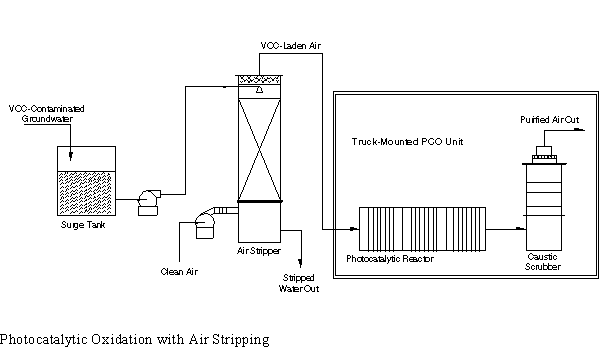
(Photocatalytic Oxidation with Air Stripping)
Chlorinated volatile organic compounds (VOC), such as trichloroethene (TCE) and perchloroethene (PCE), are readily removed from groundwater and soil using established methods such as air stripping and vapor extraction. However, this solution produces a VOC-contaminated air stream that requires further treatment.
In gas-solid photocatalytic oxidation (PCO), the VOC-laden air stream is brought in contact with a titania catalyst and near-ultraviolet (UV) light. The UV light activates the catalyst, producing oxidizing radicals. The VOCs are completely destroyed to carbon dioxide and water in an oxidation reaction that occurs at or near room temperature. The treatment of chlorinated organics also produces hydrochloric acid.
Arizona State University (ASU) is investigating an integrated pilot-scale pump-and-treat system in which chlorinated VOCs are transferred to an air stream using air stripping. A PCO reactor installed downstream from the air stripping unit treats the contaminated air stream. The figure below illustrates this system. The PCO unit incorporates a flow-through photocatalytic reactor for VOC destruction and a caustic absorber bed for removal of hydrochloric acid. The acid is neutralized to sodium chloride in the absorber bed.
PCO offers the following advantages over conventional treatment
technologies:
This technology can treat VOC-contaminated streams produced by air stripping contaminated groundwater or soil vapor extraction of contaminated soil. The technology is appropriate for dilute VOC concentrations (such as 500 parts per million by volume or less) and low to moderate flow rates. Laboratory data indicate that the PCO technology can also be adapted to industrial facilities that emit dilute VOC-contaminated air streams. Candidates include chemical process plants, dry cleaners, painting operations, solvent cleaning operations, and wastewater and hazardous waste treatment facilities. Air in closed environments could also be purified by integrating PCO units with heating, ventilation, and air conditioning systems.
The PCO technology was accepted into the SITE Emerging Technology Program in 1993. Under the program, ASU has conducted bench-scale tests to evaluate the integration of a PCO unit downstream of an existing air stripping unit. Results of the bench-scale testing have provided design data for a pilot-scale test at a Phoenix, Arizona Superfund site that is contaminated with chlorinated VOCs. ASU's previous laboratory studies indicate rapid destruction to nondetectable levels (98 to 99 percent removal) of various concentrations of TCE and other chlorinated ethenes in humid air streams.
In 1995, Zentox Corporation (Zentox) fielded a prototype PCO system for the treatment of TCE in air. Building on the data gained from that system, Zentox is fabricating a second generation system for use at the Phoenix site. Following tests at the Phoenix site, this 50- to 100-cubic-feet-per-minute pilot plant unit will be available for trials at other locations.
EPA PROJECT MANAGER:
Norma Lewis
U.S. EPA
National Risk Management Research Laboratory
26 West Martin Luther King Drive
Cincinnati, OH 45268
513-569-7665
Fax: 513-569-7787
TECHNOLOGY DEVELOPER CONTACTS:
Gregory Raupp
Department of Chemical, Biological and Materials Engineering
Arizona State University
Tempe, AZ 85287-6006
602-965-2828
Fax: 602-965-0037
E-mail: Raupp@asu.edu
Craig Turchi
Zentox Corporation
2140 NE 36th Avenue
Ocala, FL 34470
352-867-7482
Fax: 352-867-1320
E-mail: cturchi@mercury.net