(Adsorption-Integrated-Reaction Process)
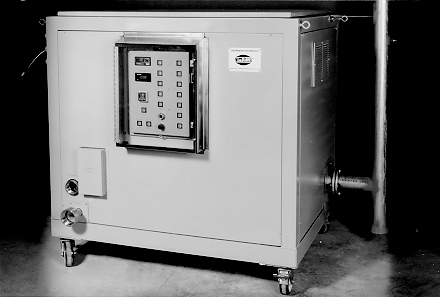
The Adsorption-Integrated-Reaction (AIR-II) process combines two unit operations, adsorption and chemical reaction, to treat air streams containing dilute concentrations of volatile organic compounds (VOC) (see photograph below).
Air-II Process Unit
The contaminated air stream containing dilute concentrations of VOCs flows into a photocatalytic reactor, where chlorinated and nonchlorinated VOCs are destroyed. The VOCs are trapped on the surface of a proprietary catalytic adsorbent. This catalytic adsorbent is continuously illuminated with ultraviolet light, destroying the trapped, concentrated VOCs through enhanced photocatalytic oxidation. This system design simultaneously destroys VOCs and continuously regenerates the catalytic adsorbent. Only oxygen in the air is needed as a reactant.
The treated effluent air contains carbon dioxide and water, which are carried out in the air stream exiting the reactor. For chlorinated VOCs, the chlorine atoms are converted to hydrogen chloride with some chlorine gas. If needed, these gases can be removed from the air stream with conventional scrubbers and adsorbents.
The AIR-II process offers advantages over other photocatalytic technologies because of the high activity, stability, and selectivity of the photocatalyst. The photocatalyst, which is not primarily titanium dioxide, contains a number of different semiconductors, which allows for rapid and economical treatment of VOCs in air. Previous results indicate that the photocatalyst is highly resistant to deactivation, even after thousands of hours of operation in the field.
The photocatalyst is particulate-based, which allows for more freedom in reactor design and more economical scale-up than reactors with a catalyst film coated on a support medium. Packed beds, annular reactors, and monolithic reactors are all feasible reactor designs. Because the catalytic adsorbent is continuously regenerated, it does not require disposal or removal from treatment for regeneration, as does traditional carbon adsorption. The AIR-II process produces no residual wastes or by- products needing further treatment or disposal as hazardous waste. The treatment system is self- contained and mobile, requires a small amount of space, and requires less energy than thermal incineration or catalytic oxidation. In addition, it has lower total system costs than these traditional technologies.
The AIR-II process is designed to treat a wide range of VOCs in air, present at low concentrations from less than 1 part per million (ppm) to thousands of ppm. The process can destroy the following VOCs: chlorinated hydrocarbons, aromatic and aliphatic hydrocarbons, alcohols, ethers, ketones, and aldehydes.
The AIR-II process can be integrated with existing technologies, such as thermal desorption, air stripping, or soil vapor extraction, to treat additional media, including soils, sludges, and groundwater.
The AIR-II process was accepted into the SITE Emerging Technology Program in 1995. Studies under the Emerging Technology Program are focusing on (1) developing photocatalysts for a broad range of chlorinated and nonchlorinated VOCs, and (2) designing advanced and cost- effective photocatalytic reactors for remediation and industrial service.
The AIR-II Process was initially evaluated at full-scale operation for treatment of soil vapor extraction off-gas at Loring Air Force Base (AFB). Destruction efficiency of perchloroethene exceeded 99.8 percent. The performance results were presented at the 1996 World Environmental Congress.
This system's forerunner, the AIR-I process, was tested extensively at the laboratory scale on chlorinated VOCs in air with concentrations ranging from 1 to 3,000 ppm. The AIR-I process was demonstrated as part of a groundwater remediation demonstration project at Dover AFB in Dover, Delaware. The process was used to treat effluent air from a groundwater stripper. Test results showed over 99 percent removal of dichloroethane (DCA) from air initially containing about 1 ppm DCA and saturated with water vapor.
EPA PROJECT MANAGER:
Vince Gallardo
U.S. EPA
National Risk Management Research Laboratory
26 West Martin Luther King Drive
Cincinnati, OH 45268
513-569-7176
Fax: 513-569-7620
TECHNOLOGY DEVELOPER CONTACT:
J.R. Kittrell
KSE, Inc.
P.O. Box 368
Amherst, MA 01004
413-549-5506
Fax: 413-549-5788