(Phytoremediation of Contaminated Soils)
Phytoremediation is the use of plants for the in situ cleanup of contaminated soils, sediments, and water. The specific technology described in this profile is the use of grasses to remediate surface soils contaminated with organic chemical wastes. Many types of organic contaminants, including pentachlorophenol (PCP), biodegrade more rapidly in planted soils than in unplanted soils.
The ability of plants to enhance biodegradation is based, in part, on plant root exudates. Plants release into the soil organic chemical exudates (sugars, acids, alcohols, and proteins) which can enhance biodegradation in the following ways: (1) the exudates stimulate soil microorganisms in the rhizosphere (the zone immediately surrounding the plant root) by serving as a food source. Rhizosphere soils contain 10 to 100 times more metabolically active microorganisms than unplanted soils; (2) exudates from the roots contain enzymes which can transform organic contaminants; (3) exudates can stimulate cometabolic transformations of contaminants by soil microorganisms.
Another important factor in phytoremediation is that plants themselves can take up and detoxify certain organic contaminants. Also, plants can stabilize soils against erosion by wind and water. Grasses appear to be ideal for phytoremediation of surface soils because their fibrous root systems form a continuous dense rhizosphere.
Organic chemical contaminants which are more rapidly removed in planted (rhizosphere) soils than unplanted soils include PCP, certain polycyclic aromatic hydrocarbons (PAH), chlorinated solvents, insecticides, and nitroaromatic explosives. For phytoremediation to be effective, soil contaminants must be in the surficial soil, within the root zone of plants (top 2 to 3 feet), and must be present at intermediate, non-phytotoxic levels. Although phytoremediation may be cost effective, especially for larger sites, it is slower than more intensive approaches (such as excavation or ex situ treatments) and may require several growing seasons.
This technology was accepted into the Emerging Technology Program in 1995 for a 2-year greenhouse and field trial. Under the Emerging Technology Program, Phytokinetics, Inc. (Phytokinetics), will demonstrate the effectiveness of the technology for surficial soils contaminated with PCP and PAHs from the McCormick & Baxter (M&B) Superfund site in Portland, Oregon. The plant species used is perennial ryegrass (Lolium perenne).
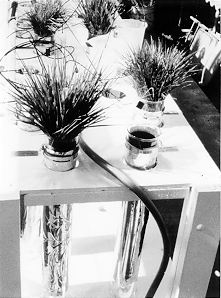
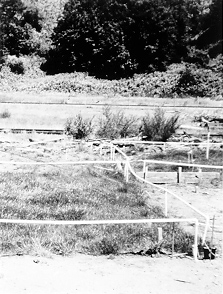
The study consists of two phases. The first phase, which began in March 1996, consists of a greenhouse study conducted under optimal conditions for plant growth. The second phase, which began in April 1996, is taking place in the field, at an area within the M&B site (see photographs below). For both phases, contaminant removal rates are being compared in planted and unplanted (nutriated) soils, as well as in unplanted unamended soils. The latter treatment allows assessment of rates of natural (intrinsic) bioremediation. Preliminary results from the first phase suggest that plants accelerate initial rates of removal of PCP, chrysene, benzo(a)anthracene, and pyrene relative to controls.
Greenhouse-Scale Phytoremediation Study
Small-Scale Outdoor Study
Phytokinetics' personnel have also conducted laboratory-scale studies using crested wheatgrass (Agropyron cristatum). The fate of uniformly radiolabeled PCP, added to soil at a concentration of 100 milligrams per kilogram (mg/kg), was compared in three planted and three unplanted systems. Employing a specifically designed flow-through test system, a budget was maintained for the PCP-derived radiolabel, and the extent of mineralization and volatilization of the radiolabel were monitored during a 155-day test.
In the unplanted systems, an average of 88 percent of the total radiolabel remained in the soil, and only 6 percent was mineralized. In the planted systems, 33 percent of the radiolabel remained in the soil, 22 percent was mineralized, and 36 percent was associated with plant tissue. Other tests using the same system were conducted with radiolabeled pyrene (initial concentrations of 100 mg/kg soil). The onset of mineralization occurred sooner in planted systems (mean = 45 days) than in uplanted systems (mean = 75 days). However, the extent of radiolabeled pyrene mineralization was the same in the two types of systems.
EPA PROJECT MANAGER:
Steven Rock
U.S. EPA
National Risk Management Research Laboratory
28 West Martin Luther King Drive
Cincinnati, OH 45268
513-569-7149
Fax: 513-569-7105
TECHNOLOGY DEVELOPER CONTACT:
Ari Ferro
Phytokinetics, Inc.
1770 North Research Park Way
Suite 110
North Logan, UT 84341-1941
801-750-0985
Fax: 801-750-6296