(X-Ray Treatment of Organically Contaminated Soils)
X-ray treatment of organically contaminated soils is based on in-depth deposition of ionizing radiation. Energetic photons (X-rays) collide with matter to generate a shower of lower- energy, secondary electrons within the contaminated waste material. These secondary electrons ionize and excite the atomic electrons, break up the complex contaminant molecules, and form highly reactive radicals. These radicals react with contaminants to form compounds such as water, carbon dioxide, and oxygen.
Other sources of ionizing radiation, such as ultraviolet radiation or direct electron beam processing, do not penetrate the treatable material deeply enough. Ultraviolet radiation heats only the surface layer, while a 1.5-million electron volt (MeV) electron penetrates about 4 millimeters into the soil. X-rays, however, penetrate up to 20 centimeters, allowing treatment of thicker samples. In situ treatment, which reduces material handling requirements, may also be possible with X-ray treatment.
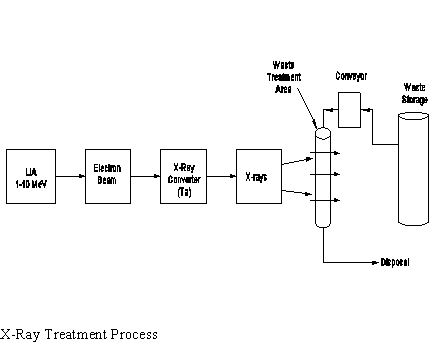
An efficient, high-power, high-energy, linear induction accelerator (LIA) plus X-ray converter generates the X-rays used in the treatment process (see figure below). The LIA energy, which must be small enough to avoid nuclear activation and as large as possible to increase the bremsstrahlung conversation efficiency, usually ranges from 8 to 10 MeV. A repetitive pulse of electrons 50 to 100 nanoseconds long is directed onto a cooled converter of high atomic number to efficiently generate X-rays. The X-rays penetrate and treat the organically contaminated soils.
The physical mechanism by which volatile organic compounds (VOC) and semivolatile organic compounds (SVOC) are removed primarily depends on the contaminant present. Because of the moisture in contaminated soil, sludge, and sediments, the shower of secondary electrons resulting from X-ray deposition produces both highly oxidizing hydroxyl radicals and highly reducing aqueous electrons. While hazardous by-products may form during X-ray treatment, contaminants and by-products, if found, may be completely converted at sufficiently high dose levels without undesirable waste residuals or air pollution.
X-rays can treat contaminated soil on a conveyor or contained in disposal barrels. Since X-rays penetrate about 20 centimeters into soil, large soil volumes can be treated without losing a significant fraction of the ionizing radiation in standard container walls. Pulse Sciences, Inc., estimates that the cost of high throughput X-ray processing is competitive with alternative processes which decompose the contaminants.
X-ray treatment of organically contaminated soils has the potential to treat large numbers of contaminants with minimum waste handling or preparation. Also, X-ray treatment can be applied in situ. In situ treatment may be of significant importance in cases where it is impossible or impractical to reconfigure the waste volume for the ionizing radiation range of electrons or ultraviolet radiation. Treatable organic contaminants include benzene, toluene, xylene, trichloroethene, tetrachloroethene, carbon tetrachloride, chloroform, and polychlorinated biphenyls.
This technology was accepted into the SITE Emerging Technology Program in 1993. A 1.2-MeV, 800-ampere (amp), 50-watt LIA and a 10.8-MeV, 0.2-amp, 10,000-watt radio frequency (RF) linac will be used in the program. The primary objectives are to (1) demonstrate that X-ray treatment can reduce VOC and SVOC levels in soils to acceptable levels, and (2) determine any hazardous by-product that may be produced.
Samples with identical initial contaminant concentration levels will be irradiated at increasing dose levels to determine (1) the rate (concentration versus dose) at which the contaminants are being destroyed, and (2) the X-ray dose required to reduce organic contamination to acceptable levels. The 10.8- MeV RF linac, which produces more penetrating X-rays, should provide information on the optimum X-ray energy for the treatment process. Increasing the accelerator energy allows a more efficient conversion from electrons to X-rays in the converter, but an upper limit (about 10 MeV) restricts the energy treatment, since higher energy activates the soil. The experimental database will be used to develop a conceptual design and cost estimate for a high throughput X-ray treatment system.
EPA PROJECT MANAGER:
George Moore
U.S. EPA
National Risk Management Research Laboratory
26 West Martin Luther King Drive
Cincinnati, OH 45268
513-569-7991
Fax: 513-569-7276
TECHNOLOGY DEVELOPER CONTACT:
Vernon Bailey
Pulse Sciences, Inc.
600 McCormick Street
San Leandro, CA 94577
510-632-5100
Fax: 510-632-5300